Over the years, I’ve spent a lot of time studying mindset, mental toughness, and personal growth.
As a certified mindset coach under retired Navy SEAL Commander Mark Divine’s Unbeatable Mind program, I’ve spent years learning and teaching tools designed to help people perform better under pressure. Things like breath control, visualization, emotional regulation, focus, purpose, and mission work.
Those tools matter.
But here’s something I’ve learned:
Mindset isn’t built by simply reading about it. It has to be trained.
You have to put yourself in situations where you’re uncomfortable, stressed, tired, frustrated, or under pressure — and then learn how to respond.
That’s one of the reasons I fell in love with Brazilian Jiu-Jitsu.
I started training in June of 2017, and somewhere along the way I realized it wasn’t just improving me physically. It was shaping the way I handle pressure in every area of life.
Training on the Five Mountains
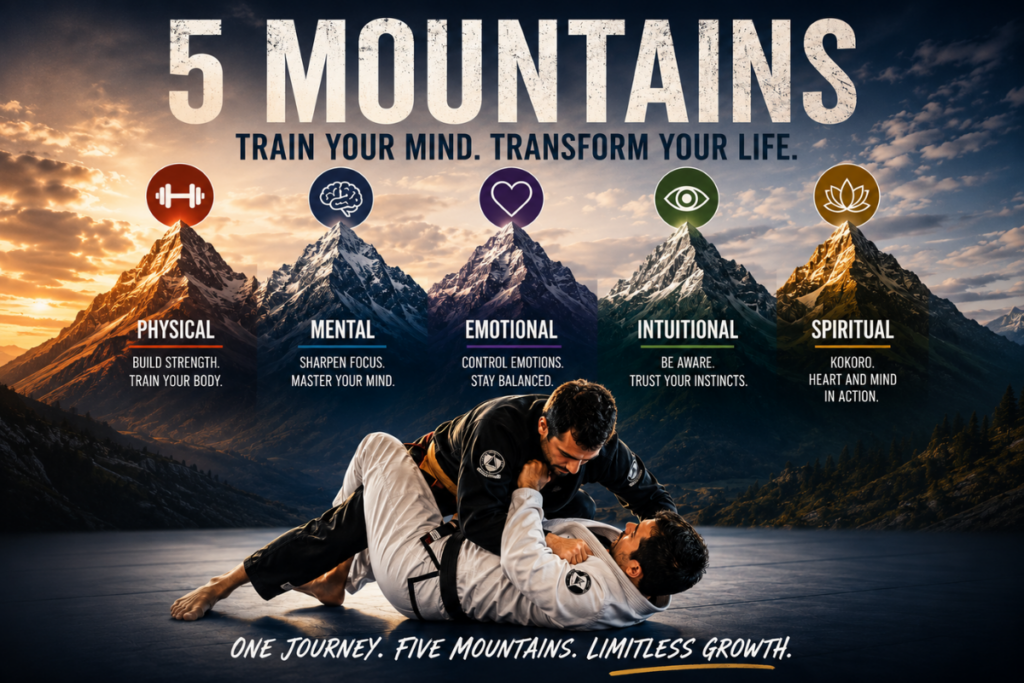
One of the concepts we talk about in Unbeatable Mind is what Mark Divine calls the Five Mountains of development:
- Physical
- Mental
- Emotional
- Intuitional
- Spiritual, or Kokoro — heart and mind in action
The goal is integrated growth.
In other words, when you’re training correctly, you shouldn’t just be improving physically. You should be strengthening your mind, emotions, awareness, and spirit at the same time.
And in my experience, Brazilian Jiu-Jitsu develops all five mountains better than almost anything else I’ve found.
The Physical Mountain
This is the obvious one.
Brazilian Jiu-Jitsu is a combat sport. It’s physically demanding in a way that surprises almost everyone the first time they step on the mat.
You’re moving constantly, fighting for position, using leverage, and controlling another human being while they try to control you.
I’ve watched runners, weightlifters, and CrossFit athletes gas out quickly their first time training. It’s just a different kind of conditioning.
But the physical side goes beyond the workout itself. Most people who train consistently also begin improving their nutrition, recovery, sleep, hydration, and overall lifestyle habits.
Jiu-Jitsu has a way of improving the entire person, not just fitness levels.
The Mental Mountain
Brazilian Jiu-Jitsu is often called “human chess,” and that description fits.
Every class involves learning techniques, solving problems, recognizing patterns, and adapting in real time.
But the mental training goes deeper than technique.
One of the biggest lessons is learning to stay calm under pressure.
When you’re exhausted, trapped underneath someone bigger than you, and your body wants to panic, breathing becomes incredibly important.
You quickly learn:
- Panic makes everything worse
- Calm creates opportunity
- Focus matters
That lesson carries over into everyday life more than most people realize.
The Emotional Mountain
This may be one of the most important parts of Jiu-Jitsu.
It forces you to confront your ego.
One of the core principles of the art is that leverage and technique can overcome strength and athleticism.
Which means eventually you’re going to lose, get submitted, and struggle.
And sometimes the person doing it to you might be smaller than you, older than you, younger than you, or less athletic than you.
I’ve been tapped out by women wearing pink gis. I’ve been caught by teenagers. I’ve been humbled plenty of times.
And honestly, that’s a good thing.
Because Jiu-Jitsu teaches emotional control.
Can you stay composed when frustrated? Can you manage fear? Can you leave your ego at the door and continue learning?
Those are life skills.
The Intuitional Mountain
The longer you train, the more intuitive Jiu-Jitsu becomes.
At first, everything feels chaotic.
But eventually you begin recognizing patterns before they fully develop.
You feel pressure shifts. You anticipate movement. You sense danger before it happens.
Some black belts seem almost impossible to attack because they already know what you’re trying to do before you do it.
That level of awareness only comes through repetition, presence, and experience.
The Spiritual Mountain: Kokoro
When we talk about the spiritual mountain, we’re not necessarily talking about religion.
We’re talking about Kokoro: heart and mind working together in action.
This is where people discover they’re capable of more than they thought.
There are moments during hard rounds where you’re exhausted, uncomfortable, overwhelmed, and ready to quit.
And then you learn to dig deeper.
Jiu-Jitsu has a way of revealing resilience you didn’t know you had.
There’s also a service component to training. Good training partners help each other improve. You’re not just there for yourself — you’re helping the people around you grow too.
The Brotherhood and Community
One thing I didn’t expect when I started training was the friendships.
Some of the best people I know today came from the gym.
There’s something about struggling, learning, sweating, and growing together that builds real relationships.
Most people who stay in Jiu-Jitsu are trying to improve themselves in some way.
That creates a very unique culture.
Final Thoughts
Brazilian Jiu-Jitsu has become one of the best mindset training tools I’ve ever found.
Not because it teaches you how to fight.
But because it teaches discipline, humility, emotional control, resilience, awareness, confidence, and patience.
And it teaches those things through experience, not theory.
It forces you to stay present.
It forces you to grow.
And if you stay with it long enough, it changes you in ways that go far beyond the mat.