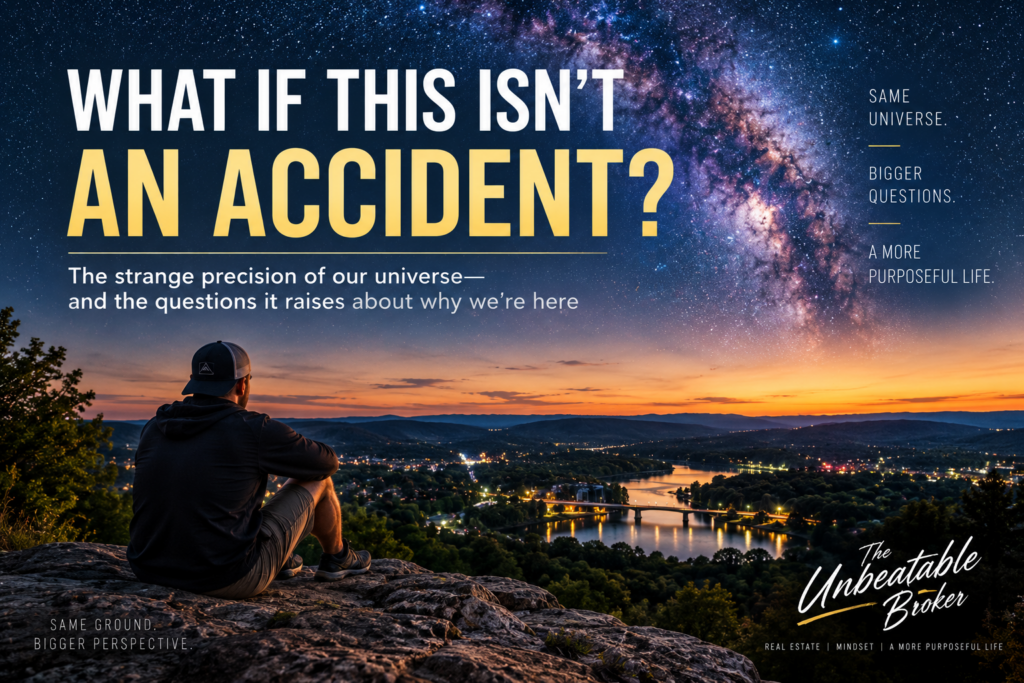
The strange precision of our universe—and the questions it raises about why we’re here
I came across an article recently that sent me down a rabbit hole.
And I mean a serious rabbit hole.
The kind where you start reading about the universe for five minutes and 45 minutes later you’re trying to understand the cosmological constant. 
The article was about something scientists and philosophers call fine-tuning.
I’d heard the term before, but the more I read about it, the more fascinating it became.
The basic idea is surprisingly simple:
Our universe operates within a remarkably specific set of physical conditions that allow stars, planets, complex chemistry—and ultimately life—to exist.
Change some of those conditions enough, and you don’t simply get a slightly different universe.
You may get a universe without stable stars.
Without complex chemistry.
Without planets.
Without anything remotely resembling the conditions necessary for life as we know it.
And that raises one enormous question:
Why?
The Universe Didn’t Have to Be This Way
Think about this for a minute.
The universe operates according to certain laws and physical constants.
Gravity has a particular strength.
Particles have particular masses and charges.
The universe expands the way it does.
Those aren’t numbers human beings invented.
We discovered them.
And physicists have found that changing some of these underlying conditions can dramatically change the kind of universe that results.
That’s the basic issue behind what has become known as the fine-tuning problem.
That doesn’t prove somebody chose the numbers.
But it certainly makes the numbers interesting.
And the deeper I went down this particular rabbit hole, the more interesting they became.
So What Are the Explanations?
This is where I think the conversation gets really fascinating.
There are several possible explanations for what we observe.
Maybe there’s some deeper law of physics we haven’t discovered yet that makes the universe the way it is.
Maybe there are an enormous number of universes with different physical properties—the idea commonly called the multiverse—and we happen to exist in one capable of producing observers.
Maybe we’re asking the probability question incorrectly in the first place.
Or…
Maybe the universe was designed.
Philosophers and physicists have debated versions of these possibilities for decades, and fine-tuning by itself doesn’t scientifically settle which explanation is correct.
And this is probably a good place for me to clarify something.
I’m not a physicist.
I’m a real estate broker who occasionally finds himself reading about theoretical cosmology when he probably should be answering emails.
So I’m certainly not going to pretend I’ve solved a question that some of the smartest people on Earth have debated for decades.
But I am a Christian.
And when I look at the universe, I can’t help seeing the fingerprints of a Creator.
Faith and Science Don’t Have to Be Enemies
People sometimes talk about faith and science as though we’re required to pick a team.
I’ve never really understood why.
If I believe God created the universe, learning more about how that universe works doesn’t threaten my faith.
It makes me want to look closer.
Science has given us extraordinary explanations for how the physical universe behaves.
How stars form.
How gravity works.
How matter interacts.
How galaxies develop.
How the universe has changed over billions of years.
But there are other questions that science, by its very nature, isn’t necessarily designed to answer.
Why is there something rather than nothing?
Why are there laws at all?
Why is the universe intelligible?
Does any of it have meaning?
Those aren’t criticisms of science.
They’re different kinds of questions.
And human beings have been asking them for a very long time.
Thousands of years ago, David looked into a night sky with no telescope, no understanding of galaxies and certainly no idea what a cosmological constant was and wrote:
“The heavens declare the glory of God; and the firmament sheweth his handywork.”
— Psalm 19:1
I wonder what David would think if we could show him what we know today.
We Should Be Careful With the Numbers
This is something else I discovered while reading about fine-tuning.
You’ll occasionally see enormous numbers thrown around online.
Someone will say the odds of our universe existing are one in 10 to some ridiculous power.
And the number sounds so enormous that the argument seems finished.
But it’s more complicated than that.
To calculate the probability of something, you need some idea of the range of possible outcomes and how likely those outcomes are.
When we’re talking about possible universes and fundamental physical constants, we don’t actually know that probability distribution.
That’s one reason philosophers caution against casually turning fine-tuning into a simple lottery calculation.
And I think Christians should be careful here too.
We don’t need to exaggerate the science to make God more impressive.
The universe is already impressive enough.
There’s nothing wrong with saying:
We don’t know.
In fact, I think there’s something healthy about it.
Intellectual humility doesn’t weaken faith.
Sometimes it makes the questions even more interesting.
Maybe Wonder Is Good for Us
Somewhere along the way, adults get really good at losing our sense of wonder.
We worry about mortgage rates.
Work.
Bills.
Politics.
The kids.
The next appointment.
What’s for dinner.
Meanwhile, we’re standing on a planet rotating through space, orbiting a star, inside a galaxy containing hundreds of billions of stars, in a universe so enormous that our brains can barely comprehend it.
And most mornings we’re irritated because somebody is driving 42 in a 45.
I’m guilty of it too.
Maybe that’s why I enjoyed going down this particular rabbit hole.
Sometimes I think it’s good to look up.
Not because looking at the stars answers every question.
Because occasionally it reminds us how big the questions really are.
Does Fine-Tuning Prove God Exists?
No.
At least, I wouldn’t make that claim.
Science doesn’t hand us a laboratory experiment labeled:
GOD: CONFIRMED.
But that’s not really how faith works anyway.
For me, the remarkable order of the universe is one piece of a much larger picture.
My faith comes from Scripture.
From the person of Jesus Christ.
From my own experiences.
And from what I believe about the world around me.
Fine-tuning doesn’t create that faith.
But it certainly gives me something to marvel at.
When I read about a universe governed by elegant physical laws…
A universe capable of producing stars…
Stars capable of producing the elements necessary for planets…
Planets capable of supporting chemistry…
Chemistry capable of supporting life…
And eventually creatures capable of looking back at the universe and asking why any of it exists…
I don’t personally see an accident.
I see creation.
Someone else can look at exactly the same universe and reach a different conclusion.
And I think that’s an important part of this conversation.
The science can tell us what we observe.
What those observations ultimately mean is a much bigger question.
There’s Something Else That Amazes Me
The more I thought about this, the more another part of the story struck me.
It’s remarkable that the universe exists.
But there’s something equally strange when you stop and think about it:
We can understand some of it.
Human beings are tiny creatures living on a relatively small planet orbiting one star among hundreds of billions in our galaxy.
Yet somehow the human mind can discover mathematical relationships that describe the movement of planets.
We can split atoms.
Detect gravitational waves.
Look billions of light-years into space.
Study light that began traveling toward us long before human beings existed.
And write equations describing things happening at scales we will never physically experience.
Albert Einstein famously remarked on how remarkable it is that the universe is comprehensible at all.
And I think that’s another question worth sitting with.
Why should the human mind be capable of understanding the universe?
Maybe there’s a perfectly natural explanation.
Maybe someday we’ll understand it much better than we do now.
I hope we do.
But for me, discovery doesn’t make creation less impressive.
It makes it more impressive.
My Take
The article that started this rabbit hole asked whether the apparent fine-tuning of the universe creates a difficult question for atheism.
Maybe it does.
But I don’t really want to make this an article about atheists.
I’d rather make it about the question.
Because I think it’s a question worth asking regardless of what you currently believe.
Why does anything exist?
Why does the universe have laws?
Why do those laws permit complexity?
Why can we understand them?
Why are we here?
I don’t pretend to have scientific answers to all of those questions.
But I do have a belief.
I believe we’re here intentionally.
I believe there is a Creator.
I believe the God responsible for those stars is the same God Scripture tells me knows us individually.
And when I really stop to think about that, it’s almost harder for me to comprehend than the size of the universe itself.
The Bottom Line
Maybe the most interesting thing about the fine-tuning debate isn’t that it gives us an answer.
Maybe it’s that it forces us to confront the question.
Science has taken us astonishingly far in understanding the universe.
And I hope it takes us much farther.
There are undoubtedly things we believe today that future generations will discover were incomplete.
There are probably questions we haven’t even thought to ask yet.
That’s exciting.
Because for me, science and faith don’t have to compete.
Science gives me another way to appreciate what I’m looking at.
King David looked into the night sky thousands of years before anyone knew about galaxies, relativity, quantum mechanics or cosmological constants and wrote:
“The heavens declare the glory of God.”
Nearly three thousand years later, we know infinitely more about those heavens than David did.
We’ve seen galaxies he couldn’t possibly have imagined.
We’ve discovered physical laws he couldn’t possibly have understood.
We’ve looked backward in time almost to the beginning of the observable universe.
And somehow, to me…
the heavens have only become more remarkable.