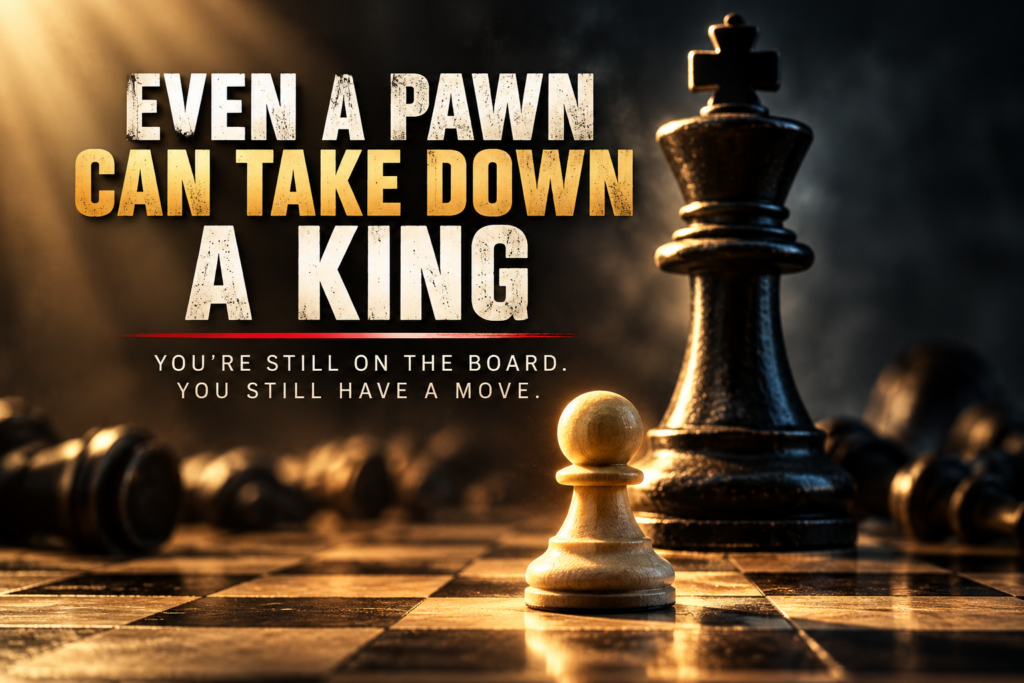
Never underestimate the power of the person everyone else overlooks.
Rebekah and I have been watching The Terminal List: Dark Wolf, and there was a line from Ben Edwards that I thought was really good.
“Even a pawn can take down a king.”
It’s one of those lines you hear in a show and immediately think:
That’s pretty damn good.
If you know anything about chess, you understand why the line works.
The king is the most important piece on the board.
The queen is the most powerful.
The rooks, bishops, and knights all have abilities that make them dangerous.
And then there’s the pawn.
You get eight of them.
They move one square at a time.
They can’t move backward.
They have limited options.
And because there are so many of them, they’re often treated as expendable.
But ignore one long enough…
And a pawn can change the entire game.
The more I thought about that, the more I realized it wasn’t really a lesson about chess.
It’s a lesson about life.
We Have a Habit of Underestimating People
We do it all the time.
We look at someone’s title.
Their experience.
Their age.
Their education.
Their bank account.
Their position in the company.
Their rank.
Their number of followers.
And somewhere in our minds, we start arranging everyone on the board.
That’s the king.
That’s the queen.
That’s an important piece.
And that person over there?
Pawn.
The problem is, life doesn’t always respect the rankings we create.
The person with the biggest title isn’t necessarily the most capable person in the room.
The biggest company doesn’t always win.
The person with the most money doesn’t always have the best idea.
The most experienced competitor doesn’t always win the match.
The established business can get disrupted by somebody working out of a garage.
And sometimes the person everyone overlooks is quietly getting better while nobody is paying attention.
There’s actually an advantage to that.
Being underestimated can be incredibly powerful.
Nobody prepares for the person they don’t believe is a threat.
Jiu-Jitsu Will Teach You This Pretty Quickly
I’ve been training Brazilian Jiu-Jitsu since 2017.
And if there’s one place where you learn not to judge people by appearances, it’s a Jiu-Jitsu academy.
Someone walks through the door who doesn’t look particularly intimidating.
Maybe they’re smaller than you.
Maybe they’re older.
Maybe they’re wearing a lower belt.
And then you start rolling with them.
About thirty seconds later you’re wondering why this unassuming human being is apparently trying to detach one of your limbs from your body. 
Jiu-Jitsu has a wonderful way of correcting your assumptions.
I’m a purple belt.
That represents years of training and experience.
But if I start believing that my belt makes me invincible against somebody with less experience, I’m probably about to learn something.
Sometimes painfully.
Because rank tells you something.
It doesn’t tell you everything.
Respect everybody.
Underestimate nobody.
That’s good advice on the mat.
It’s probably even better advice off of it.
Small Moves Don’t Look Very Impressive
There’s another reason I like the pawn metaphor.
A pawn doesn’t move very far.
Usually one square.
That’s it.
Not particularly exciting.
Nobody watching a chess match jumps out of their chair because somebody moved a pawn from E2 to E3.
But here’s the thing:
The pawn moved forward.
And then it can move forward again.
And again.
That’s how most meaningful progress actually works.
We tend to celebrate the big moments.
The promotion.
The successful business.
The black belt.
The weight loss.
The new career.
The finished degree.
The financial breakthrough.
But we don’t see all the boring little moves that came before them.
One workout.
One phone call.
One prospecting letter.
One guitar lesson.
One page of a book.
One uncomfortable conversation.
One hour spent learning something new.
One better decision.
None of those things looks particularly impressive by itself.
They’re pawns.
But put enough small moves together in the right direction and suddenly you’re standing somewhere completely different.
Everybody Wants to Be the Queen
Here’s where chess gives us an even better metaphor.
If a pawn makes it all the way across the board, something remarkable happens.
It gets promoted.
And in most cases, the player chooses a queen—the most powerful piece on the board.
Think about that.
The weakest piece on the board has the potential to become the strongest.
But there’s a catch.
It has to cross the board.
The pawn doesn’t get promoted because it has potential.
It doesn’t get promoted because it has big dreams.
It doesn’t get promoted because somebody believes in it.
It gets promoted because it kept moving.
One square.
Then another.
Then another.
That’s the part we sometimes don’t want to hear.
Everybody wants the promotion.
Everybody wants the successful business.
Everybody wants the black belt.
Everybody wants to be in great shape.
Everybody wants financial freedom.
Everybody wants the transformation.
Very few people get excited about moving one square at a time.
But that’s how you get across the board.
Don’t Discount the Small Things
This is something I’ve become more convinced of as I’ve gotten older.
We dramatically underestimate the power of small things done consistently.
Twenty minutes of exercise doesn’t feel transformational.
Do it regularly for a year.
Reading ten pages doesn’t feel transformational.
Do it every day.
Making five prospecting calls doesn’t feel like you’re building a business.
Keep making them.
Saving a little money doesn’t feel like wealth building.
Keep saving it.
Practicing guitar for twenty minutes doesn’t suddenly make you Stevie Ray Vaughan.
Trust me on that one.
But twenty minutes today makes you a little better than you were yesterday.
That’s another square.
The problem is that we live in a world obsessed with dramatic results.
We see somebody’s finish line and compare it to our starting line.
We see the queen.
We didn’t watch the pawn cross the board.
Maybe You’re the One Underestimating You
There’s another side to Ben Edwards’ quote.
Maybe the person underestimating the pawn isn’t somebody else.
Maybe it’s you.
Maybe you’ve already decided where you belong on the board.
I’m too old.
I started too late.
I don’t have enough money.
I don’t know the right people.
Someone else is better.
The market is too difficult.
I’m too far behind.
I’ve already failed once.
I’m not ready.
Maybe some of those obstacles are real.
Life isn’t fair, and pretending everybody starts from the same square would be ridiculous.
Some people absolutely begin with advantages others don’t have.
But here’s the question that matters:
Are you still on the board?
Because if you’re still on the board…
You still have a move.
Maybe it isn’t a spectacular move.
Maybe nobody applauds.
Maybe nobody even notices.
Move anyway.
You Don’t Need Everybody to Believe in You
This may be one of the most freeing lessons in life.
You don’t need everyone to understand what you’re doing.
You don’t need everyone to approve.
You don’t need everyone to think you’re capable.
You don’t even need everyone to notice.
Sometimes being overlooked gives you room to work.
Learn.
Train.
Build.
Fail.
Adjust.
Get better.
And keep moving.
While everybody else is watching the kings and queens, the pawn keeps crossing the board.
There’s something powerful about quietly doing the work.
Eventually the results introduce you.
Don’t Become the King Who Ignores the Pawn
There’s also a warning in this metaphor.
It’s easy to read this and immediately identify ourselves as the underestimated pawn.
That’s the fun version.
But sometimes we’re the king.
Sometimes we’re the ones underestimating somebody else.
The new employee.
The younger competitor.
The older guy at the gym.
The rookie agent.
The quiet person in the meeting.
The beginner.
The person without the impressive résumé.
The person who doesn’t look like much of a threat.
Be careful.
Not because everybody is secretly plotting to overthrow you.
But because arrogance creates blind spots.
The moment you believe you have nothing to learn from someone is usually the moment you’ve stopped paying attention.
I’ve found that some of the most interesting things I’ve learned have come from people I could have easily dismissed.
Humility keeps you teachable.
And being teachable keeps you growing.
My Take
I don’t think the lesson in “Even a pawn can take down a king” is that we should spend our lives trying to knock kings off the board.
I think the lesson is much simpler.
Don’t underestimate anybody—including yourself.
Respect the beginner.
Respect the competitor.
Respect the person quietly doing the work.
Respect small decisions.
Respect consistency.
Respect what can happen when somebody keeps moving forward while everyone else is watching the more impressive pieces.
You don’t have to be the most powerful person in the room.
You don’t need the biggest title.
You don’t need the most money.
You don’t need everybody to believe in you.
And you certainly don’t have to start as the king.
You just need to make the next move.
The Bottom Line
In chess, a pawn usually moves one square at a time.
It doesn’t look particularly impressive.
Until it crosses the board.
Maybe that’s worth remembering the next time you feel too small, too inexperienced, too old, too late, or too far behind.
Don’t worry about crossing the entire board today.
Move one square.
Do the workout.
Make the call.
Write the page.
Have the conversation.
Take the class.
Send the email.
Apply for the opportunity.
Try again.
Then tomorrow…
Move another square.
Because you don’t know where those small moves will eventually take you.
And you definitely shouldn’t allow somebody else’s opinion of your place on the board to determine how far you’re capable of going.
You’re still on the board.
You still have a move.
And as Ben Edwards reminds us:
“Even a pawn can take down a king.”