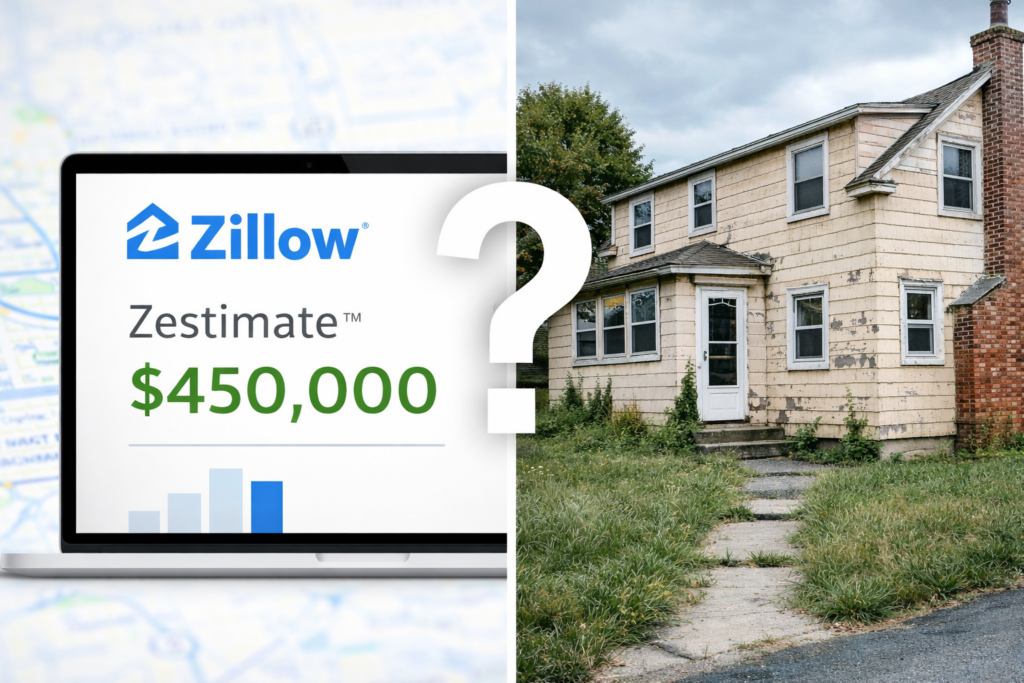
Zillow has become a go-to website for people looking for information about their home — or homes they’re interested in buying. With just an address, you can see photos, tax records, prior sales, neighborhood data, and even an estimated home value known as the Zestimate.
For many people, the Zestimate is the first number they see when they start thinking about selling or buying.
But that naturally raises an important question: How accurate is the Zestimate, really?
The answer is… sometimes very accurate — and sometimes very wrong. Understanding why can help homeowners and buyers use it wisely instead of relying on it blindly.
What Is the Zestimate?
The Zestimate is an automated home value estimate created by Zillow. It’s generated by an algorithm that analyzes publicly available data, including:
- Recent sales in the area
- Property tax records
- Home size and lot size
- Number of bedrooms and bathrooms
- Market trends
Zillow updates its algorithm regularly and even publishes accuracy statistics by market. In some areas, Zestimates can be fairly close to market value — especially for newer homes in subdivisions with lots of recent, similar sales.
But there are important limitations.
Why the Zestimate Can Be Right
There are situations where the Zestimate performs well.
1. Cookie-Cutter Neighborhoods
Homes in subdivisions where properties are similar in size and layout, built around the same time, and supported by frequent, recent sales tend to produce more accurate Zestimates. The algorithm has plenty of comparable data to work with.
2. Strong, Consistent Market Data
In areas with high sales volume, stable pricing trends, and up-to-date public records, the Zestimate often lands within a reasonable range of actual market value.
3. Recently Updated Public Records
If the tax record accurately reflects finished square footage, bedroom/bathroom count, and major permitted updates, the Zestimate has better inputs, which improves the output.
Why the Zestimate Can Be Wrong
This is where homeowners need to be careful.
1. It Can’t See Inside the Home
The Zestimate doesn’t know the condition of the home, the quality of finishes, whether the kitchen is original or renovated, or how well the home has been maintained. Two homes with the same stats on paper can be tens of thousands of dollars apart in real value.
2. It Doesn’t Understand Unique Features
Zestimates often struggle with historic homes, custom construction, unique lots, additions, layout changes, and properties with character that don’t fit a template. The more unique a property is, the harder it is for an algorithm to value it accurately.
3. It Relies on Incomplete or Outdated Data
Public records are not always current or correct. If square footage, room counts, or improvements aren’t reflected accurately, the Zestimate may be working from flawed information.
4. It Can Lag Behind the Market
In fast-moving markets, Zestimates can trail behind rising prices, miss shifts in buyer demand, or overreact to short-term trends. Markets are emotional and dynamic — algorithms are not.
5. It’s an Average, Not a Strategy
The Zestimate is designed to estimate value — not to price a home to attract buyers, account for competition, maximize net proceeds, or factor in timing and presentation. Value and market pricing strategy are not the same thing.
What the Zestimate Is (and Isn’t)
The Zestimate IS:
- A starting point
- A general reference
- One data point among many
The Zestimate is NOT:
- An appraisal
- A professional market analysis
- A pricing strategy
- A substitute for local expertise
Why Local Context Still Matters
Homes don’t sell in spreadsheets — they sell in neighborhoods.
Things an algorithm can’t fully account for include street-by-street differences, buyer perception, school and micro-location preferences, condition and presentation, and how a home compares to active competition.
This is where a local, human analysis adds real value.
Final Thought
The Zestimate can be a helpful tool — when it’s used appropriately.
It’s a great way to start a conversation, get a rough idea of value, and track general market trends. But when it comes time to buy or sell, relying on a single automated number can lead to unrealistic expectations — in either direction.
The most accurate home value comes from combining data, market activity, property condition, and local expertise.
If you’d like to get a clearer idea of what your home may bring on today’s market, I offer a free Competitive Market Analysis (CMA). It’s a no-pressure way to see how your home compares to recent sales and current competition — and what that means for your price and strategy.