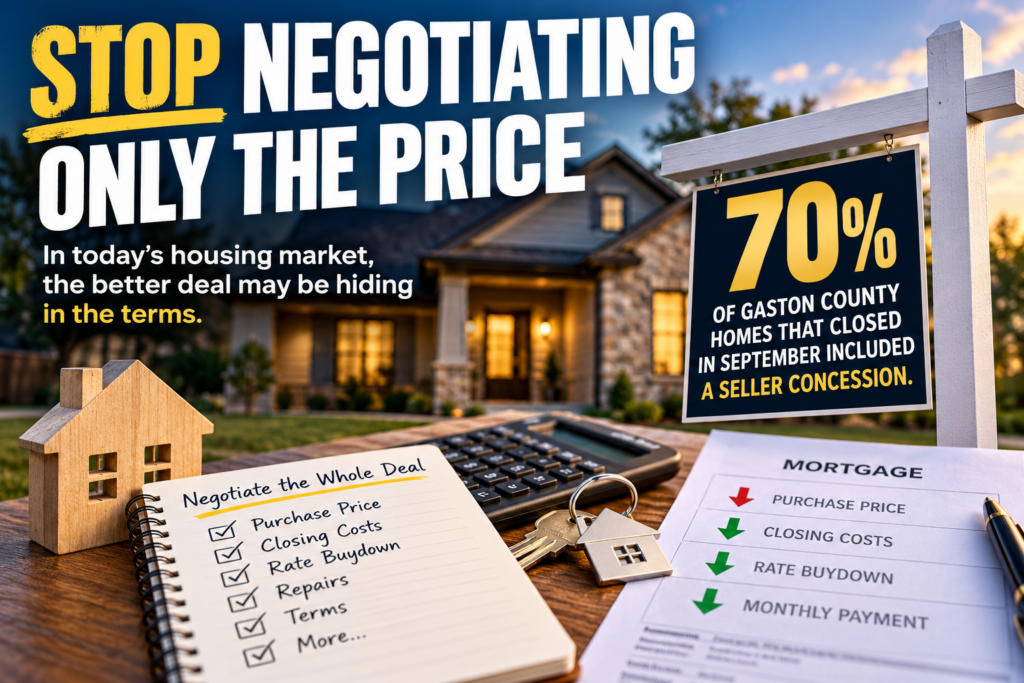
In today’s Gaston County housing market, the better deal may be hiding in the terms
For years, buyers were trained to think about negotiating a house in one way:
How much can I get them to come down on the price?
Offer $10,000 less.
Meet somewhere in the middle.
Congratulations. You negotiated a deal.
But today’s market is different.
And if you’re buying a house right now, I think there’s another question you should be asking:
What can we negotiate that actually makes this house more affordable for me?
Because those aren’t always the same thing.
70% of Gaston County Sales Included a Seller Concession
This is where things get interesting.
When I ran the numbers for my most recent Gaston County market update, 70% of the homes that closed in September included some form of seller concession.
Think about that.
Seven out of every ten sales.
That means seller concessions aren’t some unusual negotiating tactic happening occasionally around the edges of our market.
They’re showing up in the majority of our closed transactions.
And Gaston County isn’t alone.
Nationally, Redfin reported that sellers gave concessions in 44.7% of U.S. home sales in August handled by its buyers’ agents—the highest August share in its records going back to 2020.
Even more interesting, 15.8% of those transactions included both a price reduction and a seller concession.
Read that again.
Some buyers aren’t choosing between negotiating the price and negotiating the terms.
They’re negotiating both.
That’s a very different housing market from the one we had a few years ago.
Remember When Buyers Were Begging Sellers?
It wasn’t that long ago.
Multiple offers.
Offers over asking price.
Appraisal gaps.
Waiving repairs.
Very little negotiating leverage.
Sometimes buyers practically had to send the seller a family photo and promise to name their first child after them. 😂
Today?
The balance has shifted.
That doesn’t mean every house is negotiable.
A great house that’s priced correctly can still attract plenty of attention.
But when 70% of our September closings in Gaston County included seller concessions, the market is clearly telling us something.
Buyers have leverage again.
And I think buyers need to understand how to use it.
A $10,000 Price Reduction Isn’t a $10,000 Savings in Your Payment
This is where the strategy gets interesting.
Suppose you’re buying a $400,000 house and financing most of the purchase.
You negotiate the seller down $10,000.
That’s great.
You absolutely saved money.
But you didn’t reduce your monthly payment by $10,000.
You reduced the amount you’re financing by some portion of that $10,000.
Depending on your down payment, interest rate and loan structure, the monthly difference may be considerably smaller than people expect.
Now imagine instead that some or all of the seller’s negotiating dollars are used toward allowable closing costs or a mortgage-rate buydown.
That may affect your immediate cash requirement or monthly payment much more noticeably.
That’s why I think buyers need to stop looking only at the number written at the top of the contract.
Negotiate the Whole Deal
When I’m working with a buyer today, I don’t want to ask only:
“How low can we get the seller on price?”
I want to know:
What matters most to this buyer?
Maybe it’s getting the lowest purchase price possible.
Maybe cash is tight and keeping more money in the bank after closing is more valuable.
Maybe the monthly payment is the obstacle.
Maybe the house needs repairs.
Maybe the seller has been sitting on the market for 90 days and has enough equity to help us solve several of those problems.
That’s when negotiations become interesting.
Depending on the property, seller and buyer’s financing, we may be able to negotiate around things like:
- Purchase price
- Seller-paid closing costs
- Repairs
- Temporary rate buydowns
- Permanent rate buydowns
- Other lender-approved financing structures
- Due-diligence terms
- Closing date
- Personal property
- Other contract terms
Price is only one lever.
The best negotiation may involve pulling several of them.
What Exactly Is a Rate Buydown?
This is worth explaining because a lot of buyers hear the phrase without really understanding it.
A mortgage rate buydown uses money paid upfront to reduce the cost of the buyer’s mortgage, subject to the particular loan program and lender requirements.
There are different ways this can work.
A permanent buydown generally involves paying discount points upfront in exchange for a lower interest rate for the life of the loan.
A temporary buydown, such as a 2-1 buydown, works differently.
With a typical 2-1 structure, the buyer’s payment during the first year is calculated using an effective rate two percentage points below the note rate. During the second year, it’s calculated one percentage point below the note rate. After that, the buyer makes the full payment based on the note rate.
The seller may be able to fund that temporary subsidy as part of the negotiated transaction, depending on the loan program and applicable contribution limits.
And that’s an important distinction.
I’m negotiating the real estate contract. The lender needs to tell us exactly how those dollars can legally and effectively be used with your particular loan.
Then we can structure the offer accordingly.
Here’s the Question Buyers Should Ask
Instead of walking into a negotiation saying:
“Let’s offer $15,000 less.”
Try starting with:
“If the seller is willing to give us $15,000 somewhere in this deal, what’s the best way for us to use it?”
Now we’re having a strategy conversation.
Maybe we ask for the entire amount off the price.
Maybe we use part of it toward allowable closing costs.
Maybe the lender shows us that putting some toward the interest rate creates more value for this particular buyer.
Maybe we combine a price reduction with concessions.
There isn’t one answer that’s right for every buyer.
The point is to run the numbers before deciding which concession is actually worth the most to you.
This Doesn’t Mean Sellers Are Giving Houses Away
There’s another side to this.
Sellers shouldn’t read that 70% number and panic.
A market statistic doesn’t determine what happens with an individual property.
If your home is in excellent condition, priced correctly and competing against limited inventory in its particular neighborhood and price range, you may have considerably more leverage than the overall numbers suggest.
And sellers still care about their net proceeds.
A seller probably doesn’t care whether we call something a $10,000 price reduction or a $10,000 concession if one option ultimately costs them substantially more than the other.
We’re negotiating against the seller’s net, not imaginary free money.
That’s why good negotiations need to make sense for both sides.
This Is Happening Right Here in Gaston County
This is probably the most important part of the story for me.
I can show you national statistics all day long.
They’re useful for understanding the broader market.
But I’m much more interested in what’s happening here.
And our September numbers were pretty clear:
70% of Gaston County sales included a seller concession.
That doesn’t mean home prices are collapsing.
It doesn’t mean every seller is desperate.
And it certainly doesn’t mean you can make a ridiculous offer on every house and expect the seller to accept it.
What it does mean is that buyers and sellers are finding ways to make deals work.
In some cases, that’s price.
In some cases, it’s closing costs.
In some cases, it’s repairs.
In some cases, it’s helping the buyer address the cost of financing.
And in some cases, it’s a combination.
The market has changed from “How much over asking do I need to offer?” to “How can we structure this transaction so it works for both sides?”
That’s a much better negotiating environment for buyers.
My Take
For the last few years, one of the biggest obstacles for buyers hasn’t necessarily been the price of the house.
It’s been the payment.
Higher mortgage rates changed the affordability equation.
That’s why I think we’re making a mistake if every negotiation begins and ends with purchase price.
The objective isn’t to win some imaginary contest against the seller.
The objective is to structure a transaction that makes sense for you.
Sometimes that’s a lower price.
Sometimes that’s cash toward closing.
Sometimes it’s getting repairs completed.
Sometimes it’s using seller concessions strategically with your lender to reduce your borrowing costs.
And sometimes…
it’s all of the above.
The market has changed.
Our negotiating strategy should change with it.
The Bottom Line
Nationally, seller concessions are becoming increasingly common.
But I don’t need a national statistic to tell me what’s happening in our backyard.
Seven out of ten Gaston County homes that closed in September included a seller concession.
That’s telling us something.
Sellers are negotiating.
Buyers have leverage.
And in many cases, there’s more on the table than just the purchase price.
So if you’re buying a home, don’t walk into the negotiation asking only:
“How much can we get them to knock off the price?”
Ask a better question:
“How can we structure this deal so my money works hardest for me?”
Then get your real estate agent and lender talking to each other and run the numbers.
Because the lowest purchase price isn’t automatically the best deal.
The best deal is the one that puts you in the strongest financial position—at closing, every month afterward, and over the time you expect to own the home.
And if 70% of our September sales are telling us anything…
you may have more room to negotiate that deal than you think.