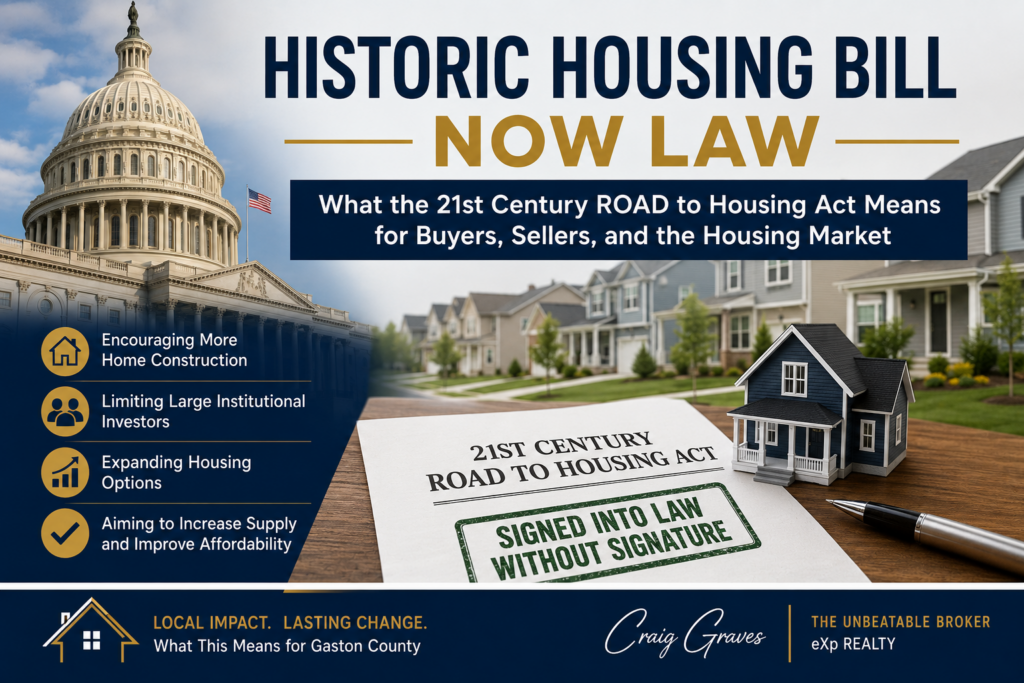
If you follow housing news, you may have noticed something unusual happened recently.
President Donald Trump did not sign one of the largest bipartisan housing bills in decades.
But he did not veto it either.
Under the U.S. Constitution, when Congress is in session, a president has ten days, excluding Sundays, to either sign or veto legislation. If neither happens, the bill becomes law without the president’s signature.
That is what happened with the 21st Century ROAD to Housing Act. After the ten-day period expired without a veto, the legislation became law.
So what exactly does the new law do?
And perhaps more importantly:
Will it actually make housing more affordable?
Why Congress Passed the Bill
The United States has faced a housing shortage for years.
Depending on the estimate, the country may be short several million homes. Basic economics tells us that when demand exceeds supply, prices generally rise.
That is part of what we have experienced across much of the country.
Higher mortgage rates have certainly affected affordability, but they are only part of the problem. The larger issue is that the country has not built enough homes to keep up with population growth and household demand.
This legislation is largely aimed at addressing that supply problem.
What Is in the Bill?
The law contains numerous provisions, but several stand out.
Encouraging More Home Construction
One of the primary goals is to reduce regulatory hurdles that can delay housing developments.
By streamlining certain federal reviews and modernizing development rules, lawmakers hope builders can bring new homes to market more quickly.
Limiting Large Institutional Investors
Another major provision attempts to curb the ability of large institutional investment firms to purchase significant numbers of single-family homes.
Supporters argue that these restrictions could give individual buyers and families a better opportunity to compete without facing as much competition from companies with access to large amounts of capital.
Expanding Housing Options
The legislation also encourages alternative housing solutions, including manufactured housing, mixed-use development, and updates to several older federal housing programs.
The goal is to create more flexibility in the types of homes and communities that can be developed.
The Potential Benefits
There is a lot to like about the legislation.
If more homes are built over the next several years, increased inventory could ease some of the upward pressure on prices.
Builders may benefit from fewer regulatory delays, while buyers could eventually see more properties available at a wider range of price points.
Potential benefits include:
- More new housing construction
- Faster approval timelines for certain developments
- More options for first-time buyers
- Greater use of manufactured and alternative housing
- Less competition from large institutional investors
- Additional inventory in communities facing housing shortages
Perhaps most importantly, lawmakers from both political parties agreed that America’s housing shortage deserves serious attention.
In today’s political climate, bipartisan agreement on a housing bill of this size is notable.
The Criticisms and Limitations
Of course, no piece of legislation is perfect.
One of the biggest criticisms is that the law may not provide much immediate relief to buyers.
It will not directly lower mortgage rates.
It will not suddenly reduce home prices.
It will also take time for new developments to be planned, approved, financed, and built.
Other criticisms include:
- The bill may not do enough to address affordable housing
- Some provisions may take years to have a measurable impact
- Local zoning rules can still prevent or delay construction
- Construction costs and labor shortages remain significant challenges
- Restrictions on institutional investors may have a limited effect in some markets
- The law does not directly address mortgage-rate affordability
There are also questions about whether the federal government can meaningfully increase housing supply without cooperation from state and local governments.
In many areas, local zoning and permitting rules are among the largest obstacles to new construction.
What It Could Mean for Gaston County
From my perspective as a REALTOR®, I do not expect buyers or sellers in Gaston County to notice dramatic changes overnight.
Real estate simply does not move that quickly.
However, the legislation acknowledges something important:
America needs more housing.
That is especially relevant in growing communities like Gaston County, where proximity to Charlotte, relative affordability, and continued population growth are attracting new residents.
Communities such as Gastonia, Belmont, Mount Holly, Cramerton, Dallas, and Stanley continue to experience demand from buyers looking for more value while remaining close to the Charlotte metropolitan area.
If the new law encourages additional construction and makes it easier to create a wider variety of housing, Gaston County could benefit over time.
Could the Bill Actually Improve Affordability?
Increased housing supply can help affordability, but it is only one part of the equation.
Housing affordability is also influenced by:
- Mortgage rates
- Inflation
- Construction costs
- Labor availability
- Land prices
- Local zoning policies
- Property taxes
- Insurance costs
- Population growth
- Consumer confidence
No single piece of legislation can solve all of those challenges.
But increasing supply addresses one of the root causes of rising home prices.
If demand continues to grow while supply remains limited, affordability will remain difficult. If builders are able to add more homes, buyers may eventually benefit from greater selection and less competition.
My Take
I do not believe this bill is a silver bullet.
It will not solve the country’s housing challenges overnight, and it may take years before we know whether its most ambitious provisions are effective.
However, I do believe it represents a positive recognition that housing supply matters.
For years, much of the housing conversation has focused on interest rates, buyer demand, and home prices. Those factors matter, but they often overlook the most basic issue:
We need more homes in the places where people want and need to live.
If this legislation helps remove unnecessary barriers, encourages thoughtful development, and creates more opportunities for individual buyers, it could provide meaningful long-term benefits.
The Bottom Line
Will this law solve America’s housing crisis?
Probably not by itself.
Could it help increase supply and improve affordability over the next five to ten years?
It has the potential to do so.
Like many things in real estate, the true impact will not be measured next month. It will be measured over several years through new construction, inventory growth, buyer opportunities, and changes in local housing costs.
This is a major piece of legislation, but its success will ultimately depend on how effectively it is implemented and whether federal, state, and local leaders work together.
What Does This Mean for You?
National housing policy makes headlines, but every real estate decision is local and personal.
Whether you are buying your first home, moving up, downsizing, investing, or simply trying to understand what your property may be worth, the right strategy depends on your goals and local market conditions.
If you are wondering how the current housing market or this new legislation may affect your plans in Gaston County or the greater Charlotte area, I would be happy to help you sort through the information.
No pressure and no sales pitch—just an honest conversation about your options.