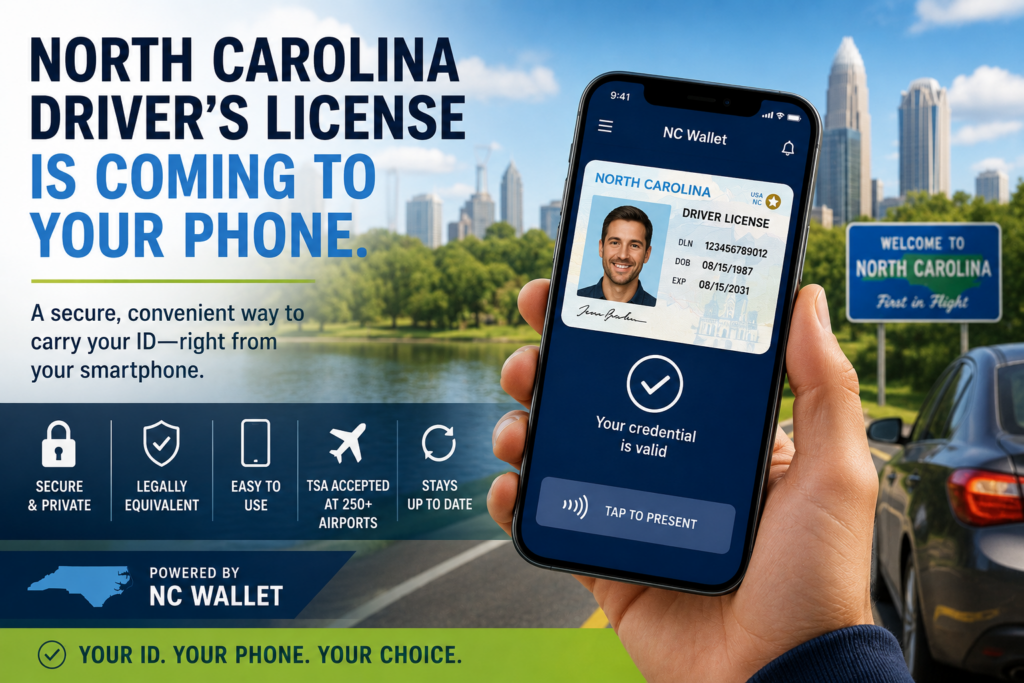
What to know about North Carolina’s new mobile ID, how it works, and what it could mean for privacy and convenience.
For years, we’ve slowly been replacing the things we carry in our wallets with our phones.
Credit cards.
Airline boarding passes.
Concert tickets.
Insurance cards.
And soon, if you live in North Carolina, you can add one more thing to that list:
Your driver’s license.
North Carolina is preparing to roll out a new mobile ID, allowing residents to carry a secure digital version of their driver’s license or state-issued ID on their smartphone.
And before you start imagining someone taking a picture of their license and saving it in their photos — that’s not what we’re talking about.
This will be an official digital credential issued by the North Carolina Division of Motor Vehicles.
How Will It Work?
When the program launches, North Carolinians will be able to download the state’s new NC Wallet.
To add your license, you’ll scan your physical driver’s license or ID and take a selfie. NCDMV will compare that information with its records to verify your identity.
Once verified, your mobile ID will be issued directly to the wallet.
One feature I particularly like is that the digital credential can stay current automatically.
If information associated with your license changes — such as adding a motorcycle or CDL endorsement — the mobile ID can update as well.
And there’s no additional charge for the mobile ID if you already have a valid North Carolina driver’s license or state ID.
Can I Finally Leave My Wallet at Home?
Eventually, maybe.
But I wouldn’t throw your physical license in a drawer just yet.
NCDMV says the mobile ID will be legally equivalent to your physical North Carolina ID. However, businesses, restaurants, and other organizations will need compatible technology to accept it.
At launch, NCDMV says the mobile ID will be accepted at its own locations and at TSA checkpoints at more than 250 airports nationwide, including Charlotte Douglas International Airport and Raleigh-Durham International Airport.
Acceptance is expected to expand as more businesses and agencies adopt the technology.
For now, I’d keep the physical license in my wallet as a backup.
What About Apple Wallet?
This was one of my first questions.
At launch, North Carolina’s mobile ID will be available through the state’s own NC Wallet rather than directly through Apple Wallet, Google Wallet, or Samsung Wallet.
NCDMV says support for those digital wallets is expected to follow in early 2027.
The state’s plans for NC Wallet also go beyond your driver’s license.
Eventually, North Carolina says residents may be able to store other government-issued credentials, receive reminders and notifications, and access government services through the app.
That could make this much more useful than simply being a digital driver’s license.
Here’s the Part I Find Most Interesting: Privacy
My first reaction to putting a government-issued ID on my phone was probably the same as a lot of people’s:
How much information am I giving someone when I use it?
Interestingly, the mobile version could actually reveal less personal information than your physical driver’s license.
Think about what happens when someone checks your physical ID.
You hand them a card containing your:
- Full name
- Home address
- Exact date of birth
- Driver’s license number
- Photograph
- Other identifying information
Even if the person only needs to know one thing — whether you’re over 21 — they can see everything printed on the card.
A mobile ID can work differently.
If a business only needs to verify that you’re over 21, the system can simply confirm that you’re old enough without necessarily sharing your exact birth date or home address.
You see what information is being requested and decide whether to share it.
That’s actually a meaningful privacy improvement.
Does the Government Track Where You Use It?
This will probably be one of the biggest concerns people have.
According to NCDMV, no.
The agency says presenting your mobile ID does not create a record allowing DMV or other government agencies to track where, when, or how you’re using it.
The system is designed so that the places where you use your ID can’t report that activity back to DMV.
Your phone can maintain an activity history for you, but NCDMV says that information is visible only to you and the feature can be turned off.
That’s an important distinction.
What Happens During a Traffic Stop?
Here’s another question that immediately came to mind:
Do I really want to hand an unlocked phone to a police officer?
You won’t have to.
NCDMV specifically says drivers using the mobile ID keep their phone in their own hand.
An officer with compatible equipment can verify the ID through a secure reader or by having you tap your phone to the officer’s device.
You do not surrender your phone.
If an officer doesn’t yet have compatible equipment, NCDMV says you may be asked to verbally provide the information from your license.
What If Someone Steals My Phone?
The mobile ID will use the security already built into modern smartphones.
Before your ID can be shared, you’ll need to authenticate yourself using something like Face ID or your fingerprint.
That’s another area where a digital ID potentially has an advantage over a traditional wallet.
If someone finds your physical driver’s license, they can immediately see everything printed on it.
If someone finds your locked phone, accessing your mobile ID is considerably more difficult.
Your Physical License Isn’t Going Away
This part is important.
Mobile IDs are optional.
North Carolina isn’t eliminating traditional driver’s licenses or forcing everyone to use a smartphone.
Physical driver’s licenses and identification cards will continue to be issued and accepted.
The mobile version simply gives residents another option.
And considering how slowly some businesses adopt new technology, keeping that physical card around is probably going to be a good idea for quite a while.
My Take
I’m interested to try it.
I’ve already reached the point where I can leave the house with little more than my phone and accomplish most of what I need to do.
My credit cards are on it.
Tickets are on it.
Directions are on it.
My calendar is on it.
Adding my driver’s license seems like the natural next step.
What surprised me while looking into this was the privacy aspect.
The idea of putting more personal information on our phones understandably makes people nervous.
But a properly implemented digital ID could actually mean sharing less information — not more.
Instead of handing someone your entire driver’s license when all they need to know is whether you’re 21, you could share only the answer to that question.
That’s pretty cool.
Of course, like any new technology, the real test will come when thousands — or millions — of North Carolinians actually start using it.
The Bottom Line
North Carolina is taking another step toward a world where the physical wallet may eventually become optional.
Your driver’s license isn’t disappearing.
But soon, you’ll have another way to carry it.
And if North Carolina can make the technology convenient, secure, and genuinely protective of our privacy, I suspect a lot of us will eventually wonder why we carried around that little piece of plastic for so long.
Now if they could just figure out how to make the DMV line disappear, we’d really be onto something.