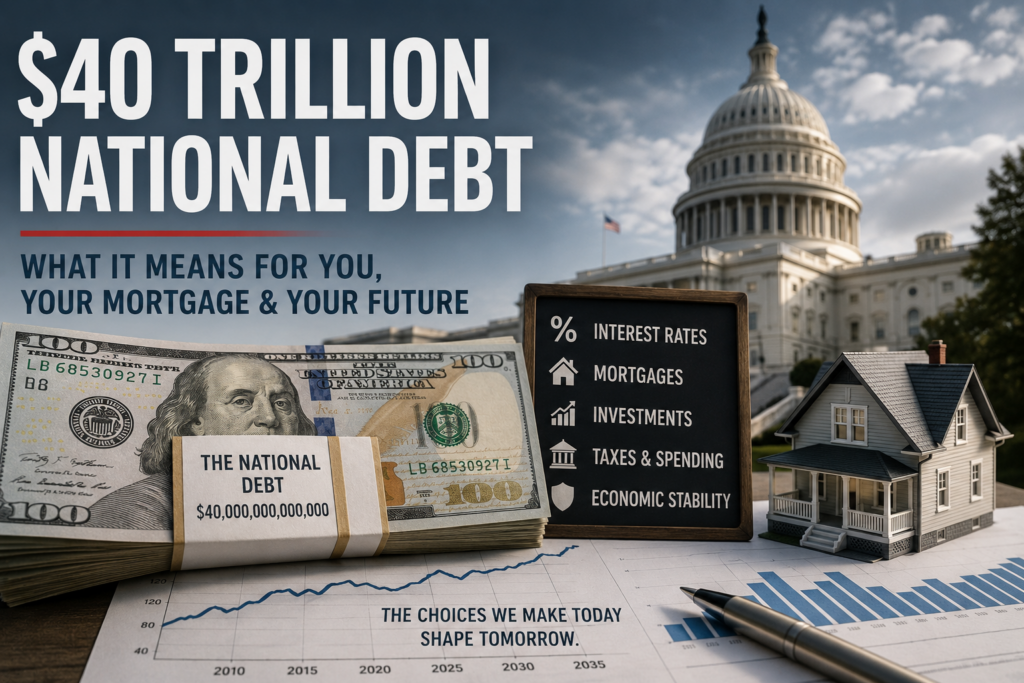
The federal debt may sound like a Washington problem, but over time it can affect mortgages, investments, taxes, and the broader economy.
When we hear politicians talk about the national debt, the numbers are so large they’re almost meaningless.
Trillions of dollars.
Annual deficits approaching $2 trillion.
Hundreds of billions of dollars in interest.
After a while, it starts sounding like Monopoly money.
And because most of us don’t write checks to the U.S. Treasury to pay down the national debt, it’s easy to think:
What does any of this actually have to do with me?
More than you might think.
The federal debt isn’t just a problem in Washington. Over time, a growing national debt can influence interest rates, mortgages, investments, taxes, and even the government’s ability to respond to the next economic crisis.
And for those of us involved in real estate, there’s one connection in particular worth understanding:
Interest rates.
First, How Big Is the Problem?
Let’s put some context around the numbers.
The Congressional Budget Office projects a federal budget deficit of about $1.9 trillion in 2026.
In other words, the federal government is expected to spend roughly $1.9 trillion more this year than it collects.
And that’s not expected to reverse anytime soon.
CBO projects annual deficits growing to approximately $3.1 trillion by 2036.
Debt held by the public is projected to rise from about 101% of the size of the U.S. economy today to roughly 120% by 2036 — higher than the record reached immediately after World War II.
But there’s another number that may be even more important.
We’re Paying Interest on All That Money
Anyone who has ever carried a credit-card balance understands this part.
Borrowing money isn’t free.
The federal government has to pay interest on its debt just like the rest of us.
CBO projects that net federal interest expense will be about $1 trillion in 2026.
By 2036?
Approximately $2.1 trillion a year.
That’s not paying down the debt.
That’s interest.
CBO projects interest costs will rise from about 3.3% of the entire U.S. economy today to 4.6% in 2036.
Think about your household budget for a moment.
Imagine if an increasingly large portion of every paycheck had to go toward interest on money you’d already spent.
Eventually, something else has to give.
That’s essentially the problem Washington faces.
So What Does This Have to Do With Your Mortgage?
This is where the national debt gets much closer to home.
To finance deficits and refinance existing debt, the Treasury sells government securities.
The more the federal government needs to borrow, the more capital it competes for in financial markets.
Over time, large and growing federal debt can put upward pressure on borrowing costs throughout the economy.
That doesn’t mean the national debt alone determines mortgage rates.
It doesn’t.
Inflation, Federal Reserve policy, economic growth, employment, investor expectations, and many other factors influence rates.
But federal borrowing is part of the equation.
And that matters when you’re financing a house.
We’ve spent a lot of time over the last few years wondering:
When are mortgage rates going back to 3%?
Maybe that’s the wrong question.
The combination of persistent inflation concerns, large government deficits, and growing federal borrowing may mean the ultra-low interest-rate environment we experienced a few years ago shouldn’t be considered “normal.”
Even CBO’s current forecast has the 10-year Treasury yield around 4.1% in 2026 and gradually rising toward roughly 4.4% later in its projection period.
That doesn’t guarantee mortgage rates stay where they are.
But it is another reason buyers shouldn’t build their entire strategy around waiting for 3% mortgages to return.
What About Home Prices?
Here’s where things get interesting.
Higher borrowing costs normally put downward pressure on housing demand because higher mortgage rates reduce purchasing power.
But there’s another side to that equation.
Existing homeowners with 3% and 4% mortgages have been reluctant to sell and replace those loans with much more expensive financing.
That can restrict housing inventory.
So higher rates can hurt affordability while simultaneously discouraging homeowners from selling.
That’s one reason today’s housing market has behaved differently than many people expected.
Higher rates didn’t automatically produce a housing crash.
Instead, in many markets, we got fewer transactions, affordability challenges, and homeowners staying put longer.
Could the Debt Affect Your Investments?
Potentially.
When the federal government borrows heavily, it competes with businesses and individuals for capital.
CBO warns that persistently rising federal debt can increase borrowing costs, reduce private investment, and eventually slow economic growth.
Again, this isn’t something that happens overnight.
The stock market isn’t going to crash tomorrow simply because the national debt crossed another trillion-dollar milestone.
But over decades, slower investment and higher borrowing costs can affect businesses, wages, retirement accounts, and the broader economy.
That’s why economists pay attention to the trajectory — not just the headline number.
Then There’s the Question Nobody Likes: Taxes and Spending
If the government continually spends more than it collects, there are only so many ways to eventually address the imbalance.
Broadly speaking, policymakers can:
- Reduce spending
- Increase revenue
- Grow the economy faster
- Borrow more
- Or use some combination of all four
None of those choices is painless.
The Congressional Budget Office has previously examined what happens when policymakers delay addressing rising debt and concluded that waiting generally requires larger policy changes later.
Younger Americans can bear a disproportionate share of those eventual adjustments.
That doesn’t tell us exactly which taxes will change or which programs might be affected.
Nobody knows that today.
But it does tell us that debt doesn’t simply disappear because we stop talking about it.
Should We Panic?
No.
And that’s an important point.
The United States isn’t a household.
The federal government issues debt in its own currency, operates the world’s largest economy, and has borrowing capabilities that you and I obviously don’t have.
So comparisons between the federal budget and a family credit card only go so far.
Nor does a large debt automatically mean an economic crisis is around the corner.
But that doesn’t mean debt doesn’t matter.
The concern is largely about the direction we’re headed.
Debt growing faster than the economy year after year means rising interest costs, less fiscal flexibility, and greater economic risk over time.
My Take
I don’t write about this because I think everyone should run out and change their investments or hide cash under the mattress.
Quite the opposite.
I think understanding the national debt helps put some of today’s economic environment into perspective.
Why haven’t interest rates fallen as quickly as people expected?
Why might mortgage rates remain higher than they were before the pandemic?
Why does Washington spend so much money simply servicing debt?
Why might future generations face difficult choices involving taxes and government spending?
The national debt isn’t the answer to every one of those questions.
But it’s increasingly part of the conversation.
And just like I tell people about real estate, we make better decisions when we understand the environment we’re operating in instead of simply wishing it were different.
The Bottom Line
A nearly $40 trillion national debt sounds like Washington’s problem.
Ultimately, it isn’t.
It can eventually show up in the interest rate on your mortgage, the cost of borrowing money, the performance of the economy, future tax policy, and the government’s ability to respond when the next recession or national emergency arrives.
You and I aren’t going to solve the federal debt.
But we can understand it.
And when it comes to our own finances, we can control the things that are actually within our reach:
- How much we borrow
- How much we save
- The investments we make
- The financial decisions we make for our families
Sometimes the biggest economic stories aren’t as far removed from our kitchen table as they initially appear.