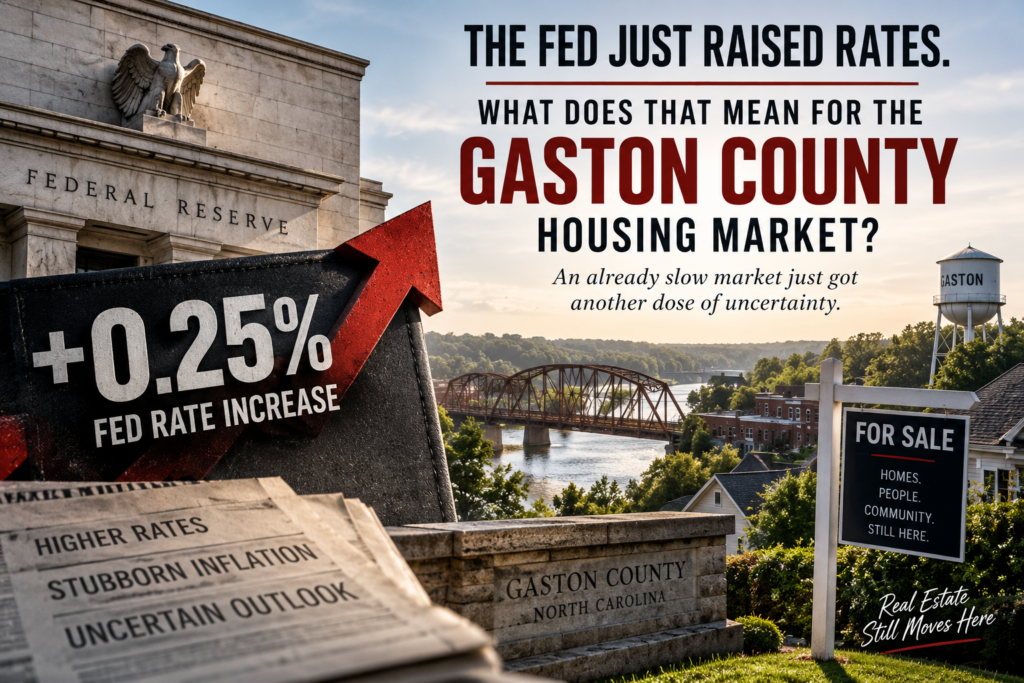
An already slow market just got another dose of uncertainty
I’ll be honest.
When I saw the Federal Reserve raised interest rates another quarter point, my first thought wasn’t complicated:
How much slower can we make an already painfully slow real estate market?
If you’re trying to sell a home right now—or you’re a real estate agent trying to sell one—you probably understand the frustration.
Homes are sitting longer.
Buyers are cautious.
Affordability is stretched.
And every time it seems like the market might finally get a little breathing room, something else comes along.
Now it’s another Fed rate increase.
So what does this actually mean for the housing market here in Gaston County?
Probably some additional pressure.
But maybe not for exactly the reason you think.
First, the Fed Doesn’t Set Mortgage Rates
This is probably the most important thing to understand.
When the Federal Reserve announces a 25-basis-point increase, that does not mean your mortgage rate automatically goes up 0.25%.
The Fed controls a short-term benchmark interest rate called the federal funds rate.
Mortgage rates—particularly 30-year fixed mortgages—are influenced much more by things like longer-term Treasury yields, inflation expectations, economic growth and what investors believe the Fed will do in the future.
Sometimes mortgage rates can actually move in the opposite direction of the Fed.
Unfortunately, that doesn’t provide much comfort at the moment.
The average 30-year fixed mortgage was already 6.76% as of September 10, according to Freddie Mac. That’s up from 6.35% a year ago.
And the bond market has also been pushing borrowing costs higher.
So while the Fed’s decision doesn’t automatically add another quarter point to a mortgage, the economic environment that caused the Fed to raise rates isn’t particularly friendly to mortgage rates either.
That’s the part I’m watching.
Why Did the Fed Raise Rates?
Inflation.
The Fed’s long-term inflation target is 2%, and inflation has remained stubbornly above that level.
The Fed raised its target range by 25 basis points, and policymakers have indicated that additional tightening could remain on the table if inflation doesn’t cooperate.
Essentially, the Fed is trying to slow demand enough to get inflation under control.
There’s an uncomfortable irony here for housing.
One of the ways higher interest rates reduce inflation is by making borrowing more expensive.
That means cars become more expensive to finance.
Credit becomes more expensive.
Businesses face higher borrowing costs.
And yes…
Homes become harder to afford.
The Monthly Payment Is the Problem
This is where interest rates become very real for homebuyers.
Consider a $300,000, 30-year mortgage.
At 6.5%, the principal-and-interest payment is approximately $1,896 per month.
At 7%, it’s approximately $1,996.
At 7.5%, it’s approximately $2,098.
That’s before taxes, insurance or HOA dues.
A half-point move in mortgage rates can therefore change the payment by roughly $100 per month on that loan amount.
For some buyers, that’s annoying.
For others, that’s the difference between qualifying and not qualifying.
And that’s why buyers are paying so much attention to rates.
What I’m Seeing in Gaston County
This is where national economic headlines collide with the local market.
I’ve been talking about this for months.
Our market isn’t dead. But it is slow.
There are buyers.
Homes are selling.
But buyers have become much more selective.
They have more choices than they did a few years ago, they’re extremely conscious of their monthly payment, and they aren’t nearly as willing to overlook condition or aggressive pricing.
Across the broader Charlotte region, homes have been taking longer to go under contract while inventory has grown, giving buyers more time and more negotiating leverage.
The same general shift is visible in our part of the market.
That doesn’t mean every neighborhood or price point behaves the same way.
They don’t.
But the direction is pretty clear:
Buyers have more leverage than they did during the frenzy a few years ago.
Another period of elevated mortgage rates probably doesn’t change that direction.
So Does This Make Our Slow Market Even Slower?
It could.
That’s the part I don’t think we should sugarcoat.
A buyer who was already uncomfortable purchasing at 6.75% probably isn’t going to become more enthusiastic if mortgage rates move toward or above 7%.
Some buyers will reduce their price range.
Some will negotiate harder.
Some will wait.
And some will leave the market altogether.
That’s how sensitive housing has become to affordability.
But there’s another side to this.
Higher Rates Don’t Mean Nobody Buys a House
People don’t buy homes solely because interest rates are attractive.
People buy because they’re getting married.
Having children.
Getting divorced.
Changing jobs.
Relocating.
Downsizing.
Retiring.
Inheriting property.
Wanting more space.
Wanting less space.
Life continues regardless of what the Federal Reserve does with interest rates.
That’s why I don’t believe the Gaston County housing market simply stops.
But the threshold for getting a buyer to act becomes higher.
And that matters tremendously for sellers.
Sellers May Have to Adjust Their Expectations
This may be the biggest takeaway.
The market of 2021 and 2022 trained sellers to expect things that simply aren’t normal.
List Friday.
Twenty showings Saturday.
Multiple offers Sunday.
Under contract Monday.
That market is gone.
Today’s buyer is looking at the house, the price and the payment.
That means sellers need to pay attention to three things:
Price. Condition. Presentation.
If your house is competing against five other homes and yours is overpriced, buyers have very little reason to compromise.
If your home needs significant work, buyers are calculating those repairs on top of an already expensive monthly payment.
And if you’ve been sitting on the market for 60, 90 or 120 days with little activity, the market may already be telling you something.
I’ve said this before:
The market always tells the truth.
Interest rates don’t change that.
They just change what buyers are willing—and able—to pay.
There May Actually Be Opportunity for Buyers
This sounds strange in an article about higher interest rates, but hear me out.
If you’re financially prepared to buy and planning to own the home for a meaningful period of time, a slower market can create opportunities that weren’t available when rates were 3%.
Back then, buyers were routinely competing against multiple offers.
Inspection protections were being waived.
Homes were selling above asking price.
Sellers had enormous leverage.
Today, buyers may have opportunities to negotiate things like purchase price, seller-paid closing costs, repairs, rate buydowns, longer due-diligence periods and other terms of the contract.
That doesn’t automatically make today a better time to buy.
The payment still has to make sense.
But price and interest rate aren’t the only two variables in a real estate transaction.
Terms matter too.
And today’s buyers may have considerably more ability to negotiate those terms.
What Happens Next?
This is the million-dollar question.
I don’t know.
And anyone who tells you with absolute certainty where mortgage rates will be six months from now doesn’t know either.
Forecasts will come out.
They’ll probably change.
We’ve watched that happen repeatedly over the last several years as inflation, Treasury yields and other economic pressures proved more persistent than expected.
So I’m not building a real estate strategy around the assumption that 5% mortgage rates are right around the corner.
Could rates fall?
Absolutely.
Could they remain around today’s levels?
Absolutely.
Could they go higher?
Unfortunately, yes.
That’s why buyers and sellers have to make decisions based on the market that actually exists—not the one we’re hoping shows up six months from now.
My Take
Would I have preferred to see the Fed lowering rates right now?
Absolutely.
As someone working every day in a housing market already struggling with affordability and slower transaction volume, another rate increase isn’t exactly what I was hoping to see.
But I also understand what the Fed is trying to do.
Persistent inflation has consequences too.
The bigger mistake would be pretending the Fed raising rates means mortgage rates automatically increased by a quarter point—or that the housing market is suddenly going to collapse.
Neither is true.
What it does mean is that the affordability problem we’ve been dealing with probably isn’t going away anytime soon.
And in Gaston County, I think that means the market continues rewarding realism.
Sellers need to price for today’s buyer.
Buyers need to shop based on today’s payment.
And both sides need to understand that the negotiating environment has changed.
The Bottom Line
The Federal Reserve just raised interest rates by 25 basis points.
That doesn’t mean mortgage rates automatically increased by 25 basis points.
But it does tell us something important about the economic environment we’re operating in.
Inflation is still a problem. Borrowing costs remain elevated. And affordability continues to be one of the biggest challenges facing the housing market.
For Gaston County, I don’t think that means people suddenly stop buying and selling homes.
Life will continue creating real estate transactions.
People will get married. Families will grow. Jobs will change. Parents will downsize. People will relocate. Estates will need to be settled.
Real estate doesn’t stop because interest rates are high. But the market does adjust.
And right now, that adjustment means buyers are cautious, sellers have to be realistic, and homes that are overpriced or poorly presented are going to have a difficult time competing.
That’s frustrating.
Believe me, I get it.
But waiting around hoping the market becomes something different isn’t much of a strategy either.
If you’re thinking about buying, the question isn’t simply, “Are rates high?”
It’s: “Does buying make sense for me at today’s price, payment and terms?”
If you’re thinking about selling, the question isn’t, “What could I have gotten for my house three years ago?”
It’s: “What is today’s buyer willing to pay for my house in today’s market?”
Those are the conversations worth having.
Because I’ve said it before and I’ll keep saying it:
The market always tells us what’s happening.
Our job isn’t to argue with it.
Our job is to understand what it’s saying, make the best decision we can with the information we have, and adjust accordingly.
And if you’re trying to figure out what any of this means for your situation here in Gaston County, that’s exactly the kind of conversation I’m always happy to have.
No pressure. No predictions.
Just an honest look at the numbers and the market we’re actually in.