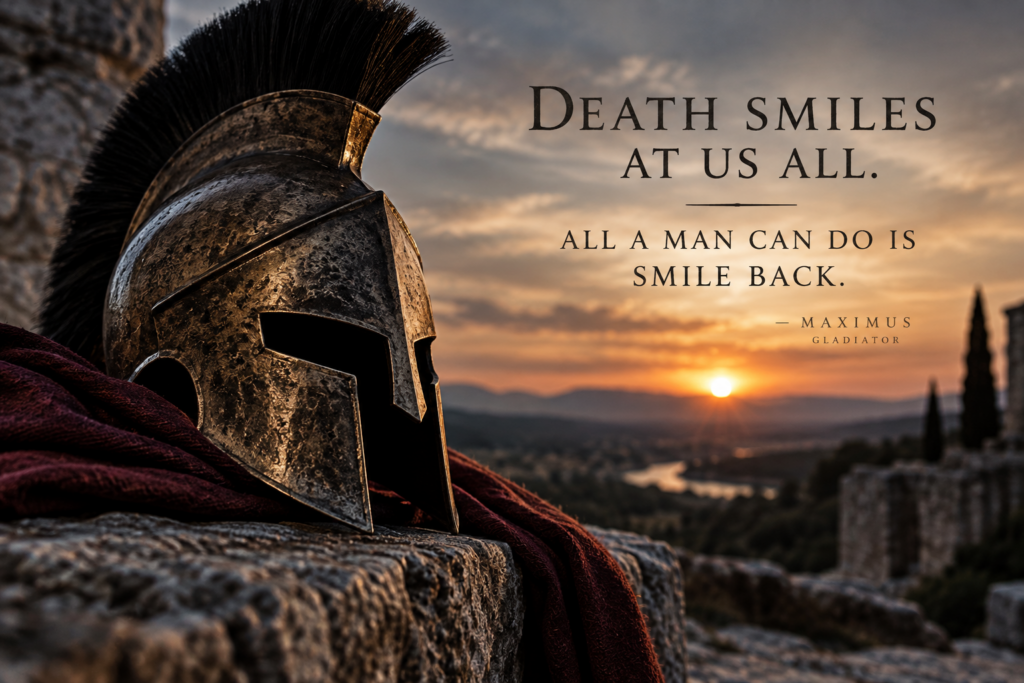
All a Man Can Do Is Smile Back.
A 1,800-Year-Old Idea About How to Live While You Still Have Time
Almost 1,800 years ago, Roman Emperor Marcus Aurelius spent a lot of time thinking about something most of us would rather not think about.
Death.
Not because he was obsessed with dying.
Because he was interested in how knowing that we will die should change the way we live.
Marcus Aurelius was a Roman emperor, but he was also one of history’s best-known Stoic philosophers. His private writings eventually became the book we know today as Meditations.
Throughout those writings, he repeatedly reminded himself that life was short, death was natural, and neither fear nor worry could change either one.
Nearly two thousand years later, Hollywood took that philosophy and gave it one hell of a line.
In Gladiator, Maximus tells Commodus:
“I knew a man once who said, ‘Death smiles at us all. All a man can do is smile back.’”
Commodus asks whether the man smiled at his own death.
Maximus answers:
“You must know. He was your father.”
The man Maximus is referring to is Marcus Aurelius.
Now, Marcus apparently never wrote those exact words. They don’t appear in Meditations. The line belongs to Gladiator.
But the philosophy behind it very much belongs to Marcus Aurelius.
He repeatedly wrote about accepting mortality rather than fearing it—and using that awareness to determine how you live today.
And that’s what I love about the line.
I don’t really think it’s about dying.
I think it’s about living.
None of us knows how much time we have.
We know how old we are. We can look at averages. We can make plans for next year, five years from now or retirement.
But the truth is, none of us has been promised any of it.
That could be depressing.
Or it could be incredibly freeing.
Because once you accept that your time is limited, a much more important question emerges:
What are you going to do with it?
We Spend a Lot of Time Acting Like We Have Unlimited Time
I’ve noticed something as I’ve gotten older.
When you’re young, time feels almost infinite.
There’s always next year.
You can get in shape later.
Start the business later.
Take the trip later.
Call your parents later.
Learn the guitar later.
Tell somebody you love them later.
Make the career change later.
Do the thing you’ve always wanted to do…later.
The problem is that eventually you start accumulating enough life experience to realize that “later” isn’t guaranteed.
People get sick.
People you love die.
Kids grow up.
Parents get older.
Friendships change.
Opportunities disappear.
And one day you look in the mirror and realize you’re not the 30-year-old who has plenty of time to figure everything out anymore.
That doesn’t scare me nearly as much as it motivates me.
I’m Not Interested in Sitting on the Sidelines
I’m at a point in my life where I’m increasingly interested in experiences.
I train Brazilian Jiu-Jitsu.
I’ve fallen in love with kettlebells.
I’m learning to play guitar.
I’m building a real estate business.
I’m trying things.
Some of them I’m good at.
Some of them I’m definitely not. 
But I’m doing them.
And I’ve become much less interested in whether I’m the “right age” to start something.
Who made that rule anyway?
There will eventually come a day when I physically can’t roll around on a mat trying to choke somebody.
There will be a day when swinging a kettlebell isn’t a great idea.
There may come a day when my hands won’t cooperate with a guitar.
But that day isn’t today.
So why would I live today as though it were?
What Does It Mean to Smile Back?
I don’t think Marcus Aurelius—or the writers of Gladiator—were suggesting that we should literally smile about death.
The idea is much bigger than that.
You acknowledge what you can’t control, and then you refuse to let it control how you live.
That’s about as Stoic as it gets.
You don’t pretend the difficult thing isn’t there.
You don’t waste your life wishing reality were different.
You decide what is still within your control—and you act on it.
That’s an important distinction.
A strong mindset isn’t pretending everything is wonderful.
I’ve never liked the version of positive thinking where you’re supposed to ignore reality and convince yourself everything will work out exactly the way you want.
Sometimes it won’t.
Deals fall apart.
Businesses struggle.
Bodies get injured.
Relationships change.
People disappoint us.
We disappoint ourselves.
And eventually every one of us will experience loss.
Mindset doesn’t change those realities.
It changes how we meet them.
Sometimes smiling back means saying:
I’m scared, but I’m going anyway.
I’m tired, but I’ve got another round in me.
I failed, but I’m going to try again.
I’m getting older, but I’m not finished.
That’s different from pretending the problem isn’t there.
That’s courage.
Faith Changes the Equation
For me, there’s another layer to this.
I’m a Christian.
And this is where my worldview goes beyond the Stoic idea of simply accepting death as part of nature.
I don’t believe death gets the final word.
Paul writes in 1 Corinthians:
“O death, where is thy sting? O grave, where is thy victory?”
That doesn’t mean Christians aren’t supposed to grieve or that death somehow stops hurting.
Jesus Himself wept when Lazarus died.
But Christianity makes an extraordinary claim:
Death is real, but it isn’t final.
And that changes how I think about both Marcus Aurelius and that line from Gladiator.
Marcus reminds me that worrying about death doesn’t change its reality.
My faith reminds me that death doesn’t have the ultimate victory.
So I don’t have to spend my life desperately trying to outrun something no human being has ever outrun.
Instead, I can concentrate on being faithful with the life I’ve been given.
Love God.
Love people.
Take care of my family.
Serve others.
Do meaningful work.
Take some chances.
Have some adventures.
And maybe laugh at myself occasionally along the way.
Actually, probably more than occasionally.
The Things We Regret Are Usually the Things We Didn’t Do
There’s something else that happens when you start thinking seriously about how limited time is.
Your priorities get a little clearer.
It’s hard to imagine getting to the end of life and thinking:
“I really wish I’d spent more time worrying about what everybody thought about me.”
Or:
“I wish I’d waited a few more years before doing the things that mattered to me.”
The regrets we hear about tend to go the other direction.
I wish I’d spent more time with my family.
I wish I’d taken the trip.
I wish I’d pursued the dream.
I wish I’d told them how I felt.
I wish I’d taken better care of myself.
I wish I’d worried less.
I wish I’d started sooner.
There’s a lesson in that.
Maybe we shouldn’t wait until we’re running out of time to start valuing it.
Someday Is a Dangerous Word
There are things that genuinely need to wait.
Timing matters.
Responsibilities matter.
Money matters.
Wisdom matters.
I’m not suggesting everybody reading this quit their job tomorrow, buy a motorcycle and head west.
But I do think we should occasionally examine the things we’ve placed in the “someday” category.
Because sometimes “someday” really means:
I’m afraid.
I’m afraid I’ll fail.
I’m afraid people will laugh.
I’m afraid I’ll look stupid.
I’m afraid I’m too old.
I’m afraid I’m not ready.
I’m afraid it won’t work.
And if that’s the only thing standing between you and something meaningful, maybe fear shouldn’t get the deciding vote.
My Take
Marcus Aurelius lived nearly 1,800 years ago.
His world looked nothing like mine.
But human beings apparently haven’t changed all that much.
We still worry.
We still fear things we can’t control.
We still waste time.
We still convince ourselves we’ll get around to living the life we want someday.
I don’t want to become obsessed with how much time I have left.
I want to become more conscious of how I’m using the time I have now.
There’s a difference.
I want to train while my body lets me train.
I want to learn things while my brain lets me learn them.
I want to build things while I have the energy to build them.
I want to spend time with the people I love while we’re all still here to enjoy it.
I want to take some risks.
I want to make some mistakes.
I want to laugh a lot.
And when life gets difficult—as it inevitably will—I want to meet it standing up.
Because none of us gets to negotiate the ending.
We do get some say in how we live the chapters before it.
The Bottom Line
Maybe that’s why a philosophy written by a Roman emperor nearly two thousand years ago still resonates today.
Marcus Aurelius understood something we occasionally forget.
Life is temporary.
We don’t control how long it lasts.
But we have an enormous amount of control over what we do with today.
Make the phone call.
Take the trip.
Start the thing.
Learn something new.
Train your body.
Strengthen your faith.
Tell people you love them.
Stop waiting for the perfect time.
And every once in a while, do something that makes you feel completely alive.
Because whether Marcus Aurelius actually said the words or Hollywood simply found the perfect way to express his philosophy, the message is worth remembering:
“Death smiles at us all. All a man can do is smile back.”
One day death will smile at all of us.
Until then, live a life that gives you every reason to smile back.