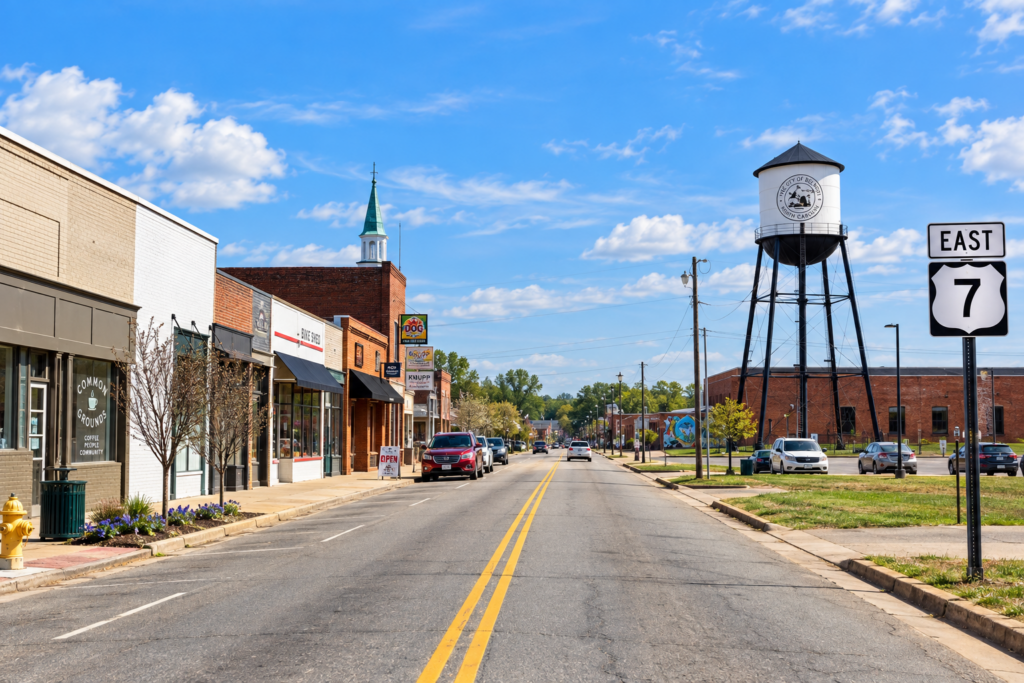
One of Belmont’s Oldest Neighborhoods Is Finding New Life
There are some places you know because you’ve studied them.
And then there are places you know because they’re simply part of your story.
For me, East End in Belmont is the latter.
When I was a young kid, my grandmother lived in the Stowe Thread Mill Village in East End. Because of my dad’s job, we lived in various places when I was growing up, so when we came back to Belmont, we spent quite a bit of time at my grandmother’s house.
Looking back, those visits ended up having a much bigger impact on my life than I probably realized at the time.
I met some of my best friends there.
Eventually, our family moved back to the area. We didn’t live in East End, but because of the friendships I’d already made, I spent a lot of my middle school and high school years there.
Then, later in life, East End actually became home.
At different times, I lived on River Drive and later on Catawba Street. During those years, I also attended Unity Baptist Church, which added another connection between me and this part of Belmont.
So East End has been part of my life in a lot of different ways.
It was where my grandmother lived when I was a kid. It’s where I made friendships that would become some of the most important friendships in my life. It’s where I spent a lot of my teenage years. And eventually, it became the place where I lived and went to church myself.
That’s a pretty long relationship with one little section of Belmont.
So when I drive through East End today, I don’t just see an area that’s changing.
I see a place I’ve watched change for most of my life.
East End Goes Back a Long Way
To understand East End, you really have to understand a little bit about Belmont itself.
Belmont’s growth was closely connected to the railroad and the textile industry. The railroad arrived in the area in the 1870s, and by the early 1900s textile mills were transforming what had been a very small community.
The growth was remarkable.
Belmont’s population was only around 145 people in 1900. By the 1930s, it had grown to nearly 4,000, with more than 20 textile mills operating in and around the community.
Those mills didn’t just provide jobs.
They created neighborhoods.
Companies built homes near their mills for employees and their families, and entire communities developed around them. Stores, churches, schools and businesses followed.
East End was very much a part of that world.
And Stowe Thread Mill Village, where my grandmother lived, was part of the fabric of that community.
For me, that’s one of the things that makes the history interesting. When we talk about mill villages today, it’s easy to think about them as historical artifacts.
For a lot of us, they weren’t history.
They were where our grandparents lived. They were where our friends lived. They were where we spent our childhood.
Look Closely and You Can Still See the Old Belmont
One of my favorite things about East End is that pieces of its history are still hiding in plain sight.
A great example is the old Majestic Mill building, which today is home to the Catawba River Antique Mall.
Then there are the older commercial buildings along East Catawba Street.
There’s an interesting story behind several of those storefronts.
During the middle part of the 20th century, older downtown buildings across America were frequently “modernized” by covering their original facades with prefabricated metal panels. Belmont was no exception.
Decades later, when some of those coverings were removed in East End, much of the original architecture was still underneath.
Restoration efforts brought those historic storefronts back to life.
I think that’s a pretty good metaphor for East End itself.
Sometimes the character of a place doesn’t disappear. It just gets covered up for a while.
River District…or East End?
If you’ve followed Belmont’s development over the years, you may also remember another name being associated with this area.
River District.
As Belmont began looking toward redevelopment and the opportunities created by its proximity to the Catawba River, there were efforts to brand this part of town as the River District.
And you can certainly understand the thinking.
Follow Catawba Street east and you’re headed directly toward the river. Today, places like Kevin Loftin Riverfront Park have helped make the Catawba River much more accessible as a recreational amenity.
City records from that period even reference “River District branding efforts.”
But today, the official downtown district is once again known as the East End District.
Personally, I think the name fits.
There’s nothing wrong with recognizing what the river means to the future of this part of Belmont. But East End already had an identity long before redevelopment became a conversation.
Sometimes progress doesn’t require giving something a new identity.
Sometimes it means finding new possibilities within the identity that’s already there.
East End Is Changing
There’s no question East End looks different today than the East End I remember as a kid.
Belmont itself is different.
The little textile town has become one of the most desirable communities in the Charlotte region. Old industrial properties have found new purposes. Historic buildings have been restored. New homes have appeared. Restaurants, shops and businesses have brought new energy to areas that once looked very different.
And the river, which was once tied heavily to industry and transportation, has increasingly become part of Belmont’s recreational identity.
That’s the interesting tension in a place like East End.
How do you make room for what’s next without erasing what came before?
I don’t think those two things have to compete.
In fact, some of the most interesting neighborhoods are the ones where you can see both.
East End Isn’t Being Created
Real estate has a funny way of making old places seem new again.
A neighborhood starts getting investment. Buildings are renovated. New homes are built. Businesses arrive.
Suddenly everyone starts talking about the area as though someone just discovered it.
But East End didn’t suddenly appear.
People raised families there.
People worked in the mills there.
Kids rode bicycles through those streets.
Friendships were formed there.
My grandmother lived there.
Some of my best childhood friendships started there.
Eventually, I lived there myself. I went to church there. It became my neighborhood too.
That’s why, when I look at what’s happening in East End today, I don’t think the story is about creating a new neighborhood.
East End isn’t being created. It’s being rediscovered.
My Take
I’m generally a fan of seeing investment come into older neighborhoods.
Restoring buildings, improving infrastructure, creating businesses and bringing homes back to life can be incredibly positive.
But I also think it’s important to remember that we’re rarely starting with a blank canvas.
Places have stories.
East End certainly does.
Some of those stories are written in old mill buildings and historic storefronts.
Others aren’t written anywhere.
They’re memories of sitting at your grandmother’s house.
They’re the kids you met down the street who somehow became lifelong friends.
They’re the streets you drove a thousand times when you were a teenager.
They’re Sunday mornings at church years later.
They’re the house you used to live in.
Those things don’t show up on a map or in a redevelopment plan, but they’re part of what gives a neighborhood its identity.
And maybe that’s why I’ve enjoyed watching what’s happening in East End.
I’m interested in where it’s going.
But I’ll always remember where it came from.
The Bottom Line
Belmont has changed tremendously since my grandmother lived in the Stowe Thread Mill Village.
It will continue to change.
So will East End.
There will be new homes, new businesses, new residents and probably plenty of new ideas about what this part of Belmont can become.
That’s a good thing.
But underneath all of that is a neighborhood with roots stretching back into the textile history that helped build Belmont in the first place.
And for those of us who’ve been around long enough, it’s also a place filled with our own history.
You can restore the buildings. You can redevelop the property. You can welcome something new.
But the best places find a way to move forward without forgetting who they are.
I think East End is doing exactly that.