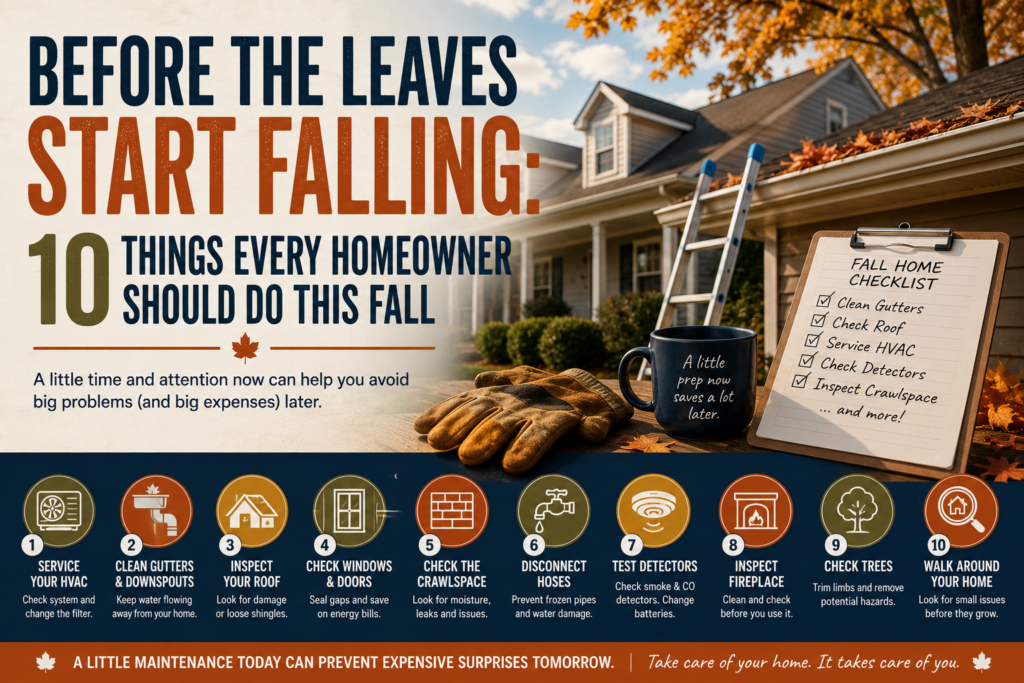
There’s something about fall that makes you want to open the windows, watch some football, fire up the grill and enjoy the fact that walking outside no longer feels like stepping into an oven. 😂
But fall is also one of the best times of year to give your house a little attention.
After walking through enough homes with buyers, sellers and home inspectors, I’ve learned something:
Some of the most expensive problems we find didn’t start as expensive problems.
They started as a small leak.
A clogged gutter.
A little moisture in the crawlspace.
A tree limb rubbing against the roof.
A furnace that hadn’t been serviced in years.
Little things have a way of becoming expensive things when they’re ignored long enough.
So before cooler weather arrives, here are 10 things I’d put on every homeowner’s fall checklist.
1. Have Your HVAC System Checked
Your air conditioner has probably been working overtime through another North Carolina summer.
Before you switch over to heat for the season, fall is a good time to have your HVAC system serviced.
A technician can inspect the system, check components and identify potential problems before you discover them on the first really cold night of the year.
And don’t forget the easiest HVAC maintenance item of all:
Change your air filter.
It’s inexpensive, takes about two minutes and can help your system operate more efficiently.
If you can’t remember the last time you changed it, that’s probably your sign. 😂
2. Clean Your Gutters and Check the Downspouts
I know.
Nobody wakes up Saturday morning excited about cleaning gutters.
But this is one of those boring maintenance jobs that can prevent much bigger problems.
Leaves, pine needles and debris can clog gutters and cause water to overflow instead of being carried away from your house.
Over time, that can contribute to damaged fascia, wood rot, foundation issues and water getting where you really don’t want it.
While you’re at it, check the downspouts.
Make sure they’re attached properly and directing water away from the foundation.
The goal isn’t simply getting water off the roof.
It’s getting it away from the house.
3. Take a Look at Your Roof
You don’t necessarily need to climb onto your roof.
In fact, depending on the roof, I’d recommend that you don’t.
But take a good look from the ground.
Do you see missing or damaged shingles?
Anything lifting?
Branches touching the roof?
Flashing that looks damaged?
Signs of deterioration around vents or the chimney?
After summer thunderstorms and before winter weather arrives, fall is a good time to identify anything that might need a professional look.
A small roof repair today is considerably more pleasant than discovering a roof problem because water is dripping through your ceiling.
4. Check Around Your Windows and Doors
Here’s an easy one.
Walk around the house and check the weatherstripping and caulking around your windows and exterior doors.
Can you feel air coming through?
Are there visible gaps?
Has the caulk cracked or pulled away?
Those little gaps can let cold air in and warm air out, making your HVAC system work harder than necessary.
A few dollars worth of caulk or weatherstripping can sometimes make a noticeable difference.
It’s not the most exciting home improvement you’ll ever make.
But neither is paying a higher heating bill. 😂
5. Give the Crawlspace a Look
If you live around Gaston County—or anywhere in this part of North Carolina—there’s a pretty good chance your house has a crawlspace.
And crawlspaces have a remarkable ability to become “out of sight, out of mind.”
That’s exactly why you should look at yours occasionally.
Check for obvious signs of moisture.
Standing water.
Wet insulation.
Musty odors.
Plumbing leaks.
Damaged vapor barriers.
Anything that just doesn’t look right.
Moisture problems underneath a house can eventually contribute to mold, wood damage and other expensive issues.
You don’t have to become a crawlspace expert.
Just don’t completely forget that there’s an entire part of your house underneath you.
6. Disconnect the Garden Hoses and Check Outdoor Faucets
This one can wait until we’re getting closer to freezing temperatures, but put it on your list now.
Disconnect your garden hoses before the first freeze.
Leaving a hose attached can trap water in the faucet and plumbing. If that water freezes and expands, you could end up with a damaged faucet—or worse, a burst pipe.
If your home has shutoff valves for exterior faucets, make sure you know where they are.
And if you have irrigation, a pool or other outdoor plumbing, make sure you understand what needs to be winterized.
North Carolina winters may not be Minnesota winters.
Water still freezes here.
7. Test Your Smoke and Carbon Monoxide Detectors
This might be the most important item on the entire list.
Test your smoke detectors.
Test your carbon monoxide detectors.
Replace batteries where appropriate and replace any detectors that have reached the end of their recommended service life.
As we move into the season when fireplaces, furnaces and other heating equipment get more use, it’s worth taking a few minutes to make sure those devices are working.
This isn’t about protecting the house.
It’s about protecting the people inside it.
8. Have the Fireplace and Chimney Inspected
If you use a wood-burning fireplace, don’t wait until the first cold Saturday night to discover there’s a problem.
Chimneys can accumulate creosote, which is combustible, and animals or debris can sometimes obstruct the flue.
If the fireplace gets regular use, consider having it professionally inspected and cleaned as appropriate.
Gas fireplaces deserve attention too.
Make sure they’re operating correctly before you need them.
There’s nothing quite like that first fire of the season.
There’s also nothing quite like filling the living room with smoke because you forgot to check the chimney. 😂
9. Look Up—Check the Trees Around Your House
Fall is a great time to look at the trees surrounding your property.
Are there dead limbs?
Branches hanging over the roof?
Limbs touching the house?
Trees leaning in ways they didn’t before?
We’re fortunate to have beautiful mature trees throughout Gaston County, but trees and houses don’t always coexist peacefully.
A dead branch that doesn’t look particularly concerning on a calm September afternoon can become considerably more interesting during a winter storm.
If something looks questionable—especially a large tree or limb—have a qualified tree professional evaluate it.
10. Walk Around Your House Like You’ve Never Seen It Before
This might be my favorite item on the list.
Take 15 minutes and walk around your property.
But try to look at it like you’re seeing the house for the first time.
Look at the siding.
Foundation.
Deck.
Porches.
Driveway.
Exterior paint.
Drainage.
Fences.
Doors.
Landscaping.
Then walk through the inside.
Look underneath sinks.
Look around toilets.
Look at ceilings.
Check the attic if it’s safely accessible.
Listen for things.
Smell for things.
Pay attention.
We become so accustomed to our own homes that it’s incredibly easy to stop noticing them.
That little water stain?
“It’s been there forever.”
That loose deck board?
“I need to fix that sometime.”
That dripping faucet?
“It’s not that bad.”
Those are exactly the kinds of things that eventually make their way onto an inspection report when you decide to sell.
And occasionally that little thing you’ve ignored turns out not to be so little.
You Don’t Have to Do Everything This Weekend
If you’re reading this thinking I’ve just ruined your Saturday, that’s not the idea. 😂
You don’t need to tackle all 10 things tomorrow.
Pick a couple.
Do those.
Then do a couple more next weekend.
Homeownership is really just a long series of small maintenance decisions.
And usually, taking care of something before it becomes a problem is considerably cheaper than fixing it after it becomes one.
My Take
One of the benefits of working in real estate is getting to see homes through the eyes of inspectors.
You start noticing things differently.
And one lesson comes up over and over again:
Deferred maintenance compounds.
The $20 problem gets ignored.
Then it becomes the $200 problem.
Then the $2,000 problem.
And sometimes it becomes the item that scares a buyer during an inspection because nobody addressed it when it was small.
You don’t need a perfect house.
There probably isn’t one.
But taking care of the little things along the way protects your investment, makes your home more enjoyable to live in and makes life considerably easier when the day eventually comes to sell it.
The Bottom Line
Fall is a natural transition point.
The weather cools down. The leaves start changing. The days get shorter.
It’s also a great reminder to spend a little time taking care of the place you call home.
Service the HVAC. Clean the gutters. Check the roof. Look for moisture. Test the detectors. Walk the property.
Nothing particularly exciting.
But that’s the funny thing about home maintenance.
The boring stuff you take care of today can save you from some pretty exciting repair bills tomorrow. 😂
Take care of your house.
It has a pretty important job.
It takes care of you.