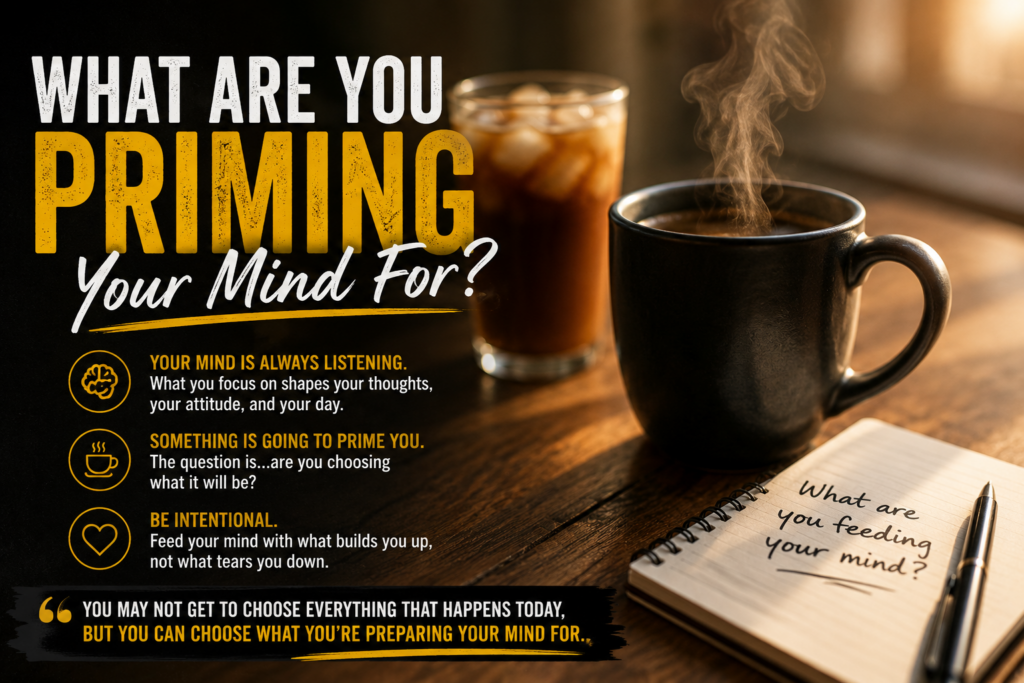
A while back, I heard Tony Robbins tell a story about an experiment involving something incredibly ordinary:
A cup of coffee.
People participating in a study were briefly asked to hold a cup of coffee for someone. Some were handed a hot cup. Others were handed an iced cup.
Later, they were given information about a stranger and asked to evaluate that person’s personality.
Here’s where it gets interesting.
The people who had held the hot coffee tended to perceive the stranger as having a “warmer” personality. Those who had held the iced coffee tended to perceive the same person as less warm.
Same basic information.
Different perception.
Potentially influenced by something as insignificant as the temperature of the cup they had been holding.
When I first heard that story, I thought it was fascinating.
But then I started thinking about something much bigger.
If something that small can potentially influence how we see the world, what else is influencing us without our realizing it?
Your Mind Is Taking In More Than You Think
Think about what happens during the first hour of a typical morning.
You pick up your phone.
Maybe you check email.
Maybe you scroll Facebook.
You see a political argument.
A terrible news story.
Someone complaining about something.
An email from work.
A problem you need to solve.
Maybe you haven’t even gotten out of bed yet.
And without realizing it, you’ve already started telling your brain what kind of day this is going to be.
Stressful.
Frustrating.
Chaotic.
Negative.
Then we walk into the rest of our day wondering why we’re already irritated.
Maybe we’ve been priming ourselves for it.
So What Exactly Is Priming?
In psychology, priming generally refers to the idea that exposure to one stimulus can influence how we respond to something that comes afterward.
The coffee experiment I mentioned was published in Science in 2008 by researchers Lawrence Williams and John Bargh. Participants who briefly held a hot cup of coffee subsequently rated another person as having a warmer personality than participants who held iced coffee.
It’s a fascinating experiment.
It’s also worth pointing out that later researchers had difficulty replicating the effect, so I wouldn’t tell you that holding a hot cup of coffee is some scientifically proven trick that will suddenly make you like everybody. 😂
That’s really not the point anyway.
What interests me is the larger question the experiment raises:
How much of our mental state is being influenced by what we repeatedly expose ourselves to?
And more importantly:
How much of that are we choosing?
Something Is Going to Get Your Attention
Tony Robbins talks a lot about intentionally “priming” yourself.
I think there’s something valuable in that idea.
Because whether we intentionally prime our minds or not, something is going to get our attention.
The news will.
Social media will.
Other people’s opinions will.
Problems will.
Politics will.
Fear will.
Comparison will.
Your inbox certainly will. 😂
None of those things are necessarily bad. We need to know what’s happening in the world. We need to deal with problems. We need to answer emails and pay attention to our responsibilities.
But there’s a difference between being informed by something and allowing it to set the emotional temperature of your entire day.
That’s where I think intentionality matters.
What Are You Feeding Your Mind?
I’ve always believed that training the mind isn’t that different from training the body.
If I eat garbage every day, eventually my body is going to reflect it.
Why would my mind be any different?
If I constantly consume outrage, negativity, fear, comparison and complaining, shouldn’t I expect some of that to eventually show up in the way I think?
On the other hand, what happens if I intentionally expose myself to things that strengthen me?
- Scripture
- Prayer
- Good books
- Exercise
- Gratitude
- Positive conversations
- People who challenge me
- Ideas that make me think
- Time without a screen in front of my face
None of that means pretending problems don’t exist.
A strong mindset isn’t about ignoring reality. It’s about preparing yourself to deal with reality well.
There’s a huge difference.
You Don’t Have to Control the World
One of the easiest traps to fall into is believing that we’ll feel better once everything around us gets better.
Once work calms down.
Once the deal closes.
Once the kids get through whatever they’re going through.
Once the election is over.
Once interest rates come down.
Once we have more money.
Once life gets easier.
The problem is that there will always be another once.
We can’t control everything that happens around us.
But we can have much more influence over what we give our attention to.
And I’ve found that what I focus on has an enormous impact on how I respond to everything else.
That’s why the first few minutes of the day matter.
Before the world starts telling me what deserves my attention, I want to have some say in the matter.
My Morning Prime
For me, this doesn’t need to be complicated.
I don’t think you need a 47-step morning routine that requires waking up at 3:45 AM, jumping into an ice bath and journaling while standing barefoot in the grass. 😂
It can be simple.
Start the day with prayer instead of Facebook.
Read some Scripture before reading the news.
Think about what you’re grateful for.
Move your body.
Decide what actually matters today.
Remind yourself who you want to be when things don’t go according to plan.
Because they won’t.
That’s the real test.
The goal isn’t to create a morning so peaceful that nothing bad happens afterward.
The goal is to prepare your mind so you’re ready when it does.
The Other Side of Priming
There’s another part of this that I think we sometimes overlook.
We’re not just being influenced by other people.
We’re influencing them too.
Our attitude enters the room before we realize it.
If we’re constantly negative, people feel it.
If we’re constantly complaining, people hear it.
If we’re calm when everyone else is panicking, people notice that too.
If we encourage people, listen to them and bring some positive energy into their day, that has an effect.
Maybe the question isn’t only:
What am I allowing to influence me?
Maybe it’s also:
What am I bringing into the lives of the people around me?
That’s a much more challenging question.
My Take
I don’t believe we can think our way into a perfect life.
Bad things happen.
People disappoint us.
Businesses struggle.
Deals fall apart.
People we love get sick.
Plans don’t work.
No amount of positive thinking changes those realities.
But mindset was never supposed to eliminate difficulty.
It’s supposed to help us become the kind of person who can walk through difficulty without allowing it to determine who we become.
That’s why I’m becoming increasingly careful about what gets access to my mind.
Not because I want to hide from the world.
Because I want to be prepared for it.
The Bottom Line
Maybe that coffee experiment doesn’t prove everything people have claimed about priming.
But it asks a question worth considering.
If something as simple as holding a cup of hot or cold coffee might affect the way we perceive another person…
what are the things we expose ourselves to every single day doing to us?
What are you watching?
What are you reading?
Who are you listening to?
What conversations are you having?
What are you telling yourself?
And perhaps most importantly:
What are you putting into your mind before the rest of the world gets a chance?
You may not get to choose everything that happens today.
But you can choose what you’re preparing your mind for.
Something is going to prime you.
You might as well have a say in what it is.